

What Is a WAAM Lab System and How Does It Support Additive Manufacturing Research?
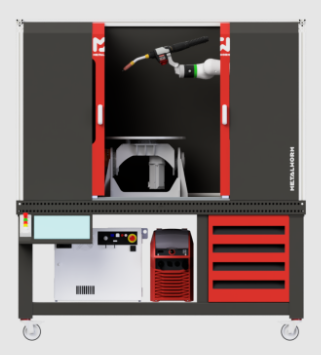
Wire Arc Additive Manufacturing research requires more than a welding source and a robotic arm. Researchers must control material deposition, robot movement, heat input, layer geometry, interpass temperature, wire-feed behaviour, and process data while maintaining a repeatable experimental environment.
Table of Contents
A WAAM Lab System brings these capabilities together in a compact robotic platform developed specifically for academic research, industrial R&D, process development, and material testing.
MetalWorm MW-LAB is designed to help researchers and engineers study Wire Arc Additive Manufacturing under controlled conditions. It combines collaborative robotics, wire-based metal deposition, advanced control mechanisms, process monitoring, and optional multi-axis positioning.
The system enables institutions to investigate new alloys, optimize deposition parameters, develop in-situ control methods, create digital twins, and study the relationship between process conditions and final part quality.
What Is a WAAM Lab System?
A WAAM Lab System is a research-oriented robotic additive manufacturing platform that deposits metallic wire layer by layer using an arc-based heat source.
In the WAAM process, metal wire is continuously supplied to a deposition torch. The arc melts the wire and creates a molten pool on a substrate or previously deposited layer. A robot moves the torch along a programmed path, allowing the material to solidify into a three-dimensional component.
Unlike a full-scale production system, a laboratory platform is optimized for flexibility, experimentation, and process observation. Researchers can adjust variables, test different materials, compare toolpaths, and measure how changes affect deposition quality.
The MetalWorm MW-LAB uses a collaborative robot architecture intended to simplify programming and make the system more accessible for research teams, students, and engineers.
Its compact design makes it suitable for universities, technical institutes, corporate R&D centres, and material-development laboratories that need an advanced WAAM platform without installing a large production cell.
How Does the MetalWorm MW-LAB Work?
The research process begins with a digital CAD model or experimental geometry. The design is converted into robotic deposition paths using programming and additive manufacturing software.
The robot guides the deposition torch while metallic wire is melted and deposited in controlled layers.
A typical research workflow includes:
Selecting the metal wire and substrate
Defining the experimental geometry
Creating the robotic toolpath
Setting wire-feed and arc parameters
Establishing the thermal-control strategy
Depositing the material layer by layer
Monitoring temperature and process behaviour
Inspecting bead geometry and surface condition
Testing the deposited sample
Comparing physical results with process data
This workflow allows researchers to study both the manufacturing process and the properties of the resulting material.
An optional compact positioner can provide additional movement axes. By rotating or tilting the workpiece, researchers can investigate more complex deposition directions and synchronized robot-positioner motion.
Easy Programming with a Collaborative Robot
Robotic programming can be a barrier for research teams that do not have extensive industrial automation experience.
MW-LAB uses a collaborative robot, or cobot, to support simpler setup and programming. Researchers can create and modify paths without relying entirely on complex conventional robot programming.
Easy programming is useful for:
-
Student training
-
Rapid experimental setup
-
Toolpath comparison
-
Small-batch research samples
-
Deposition-path development
-
Robot and positioner coordination
-
Testing different component orientations
This flexibility allows researchers to spend more time studying materials and process behaviour rather than managing lengthy robot-programming procedures.

Stable Arc Deposition with CMT
Arc stability has a direct effect on bead geometry, heat input, spatter, layer consistency, and final material quality.
The MetalWorm Lab System can use Cold Metal Transfer, commonly known as CMT, to support controlled wire deposition. CMT is associated with controlled metal transfer and comparatively low heat input.
For WAAM research, stable arc behaviour helps create a repeatable experimental foundation.
Researchers can investigate how changes in current, voltage, travel speed, wire-feed rate, layer height, and cooling time affect:
Bead width
Bead height
Surface condition
Layer bonding
Thermal accumulation
Distortion
Microstructure
Mechanical properties
A stable deposition platform helps separate the effects of individual variables and improves the reliability of experimental comparisons.
WAAM Process Development
One of the main uses of a WAAM Lab System is process development.
Every combination of alloy, geometry, heat source, wire diameter, toolpath, and build strategy may require a different parameter window.
Researchers can use MW-LAB to develop and validate:
Wire-feed rates
Robot travel speeds
Arc current and voltage
Shielding-gas settings
Torch angles
Layer heights
Interpass temperatures
Deposition sequences
Cooling intervals
Multi-axis toolpaths
The objective is to identify stable process conditions that produce consistent layers and the required material properties.
This knowledge can later support the transfer of a process from the laboratory to an industrial Compact or Special WAAM System.
New Alloy Processing and Material Research
WAAM research is not limited to existing commercial welding wires. Laboratories can also investigate new alloys, modified wire compositions, and application-specific materials.
Potential research areas include:
Steel alloys
Stainless steels
Aluminium alloys
Titanium alloys
Nickel-based alloys
Copper-based materials
Functionally graded materials
Multi-material deposition
Researchers can analyse deposited samples through metallography, hardness testing, tensile testing, fatigue testing, chemical analysis, and non-destructive evaluation.
The results help establish relationships between process parameters, thermal history, microstructure, and mechanical performance.
This makes the WAAM Lab System relevant to metallurgy departments, material-science institutes, aerospace research centres, defense laboratories, and industrial alloy developers.
In-Situ Process Control
In-situ control means observing and managing the deposition process while manufacturing is taking place.
Sensors can monitor factors such as temperature, arc behaviour, torch distance, layer geometry, and environmental conditions. Software can then use this information to detect deviations or adjust the process.
Research into in-situ control may include:
Maintaining consistent torch distance
Controlling interpass temperature
Measuring deposited layer height
Detecting arc instability
Monitoring bead geometry
Adjusting robot movement
Modifying travel speed
Identifying process anomalies
These capabilities are important for moving WAAM from an open-loop deposition method toward a more adaptive and controlled manufacturing process.
Digital Twin Development
A digital twin is a virtual representation of the physical WAAM system and manufacturing process.
Researchers can use a digital twin to connect CAD geometry, robotic motion, deposition parameters, sensor data, temperature measurements, and actual build results.
This allows teams to:
Visualize the manufacturing process
Compare planned and actual geometry
Monitor robot movement
Analyse process data
Investigate deviations
Improve future toolpaths
Support traceability
Develop predictive-control strategies
Digital twins are an important part of Industry 4.0 because they connect physical manufacturing with data-driven modelling and decision-making.
Who Can Use a WAAM Lab System?
MetalWorm MW-LAB can support:
Universities and engineering colleges
Metallurgy and material-science departments
Additive manufacturing research centres
Welding research laboratories
Aerospace and defense R&D teams
Automotive research departments
Corporate innovation centres
Government laboratories
Technical training institutes
The system can be used for teaching, thesis projects, sponsored research, material development, process validation, robotic programming, and Industry 4.0 studies.
Conclusion
A WAAM Lab System provides a flexible platform for researching robotic metal deposition, new alloys, process parameters, in-situ control, and digital manufacturing. MetalWorm MW-LAB helps academic and industrial teams develop WAAM knowledge in a controlled environment before transferring validated processes to larger production systems.
FAQ's
1. What is a WAAM Lab System used for?
A WAAM Lab System is used for Wire Arc Additive Manufacturing research, alloy testing, process development, robotic programming, thermal analysis, in-situ monitoring, and digital twin studies.
2. Who can use the MetalWorm MW-LAB?
MW-LAB is suitable for universities, engineering colleges, research laboratories, corporate R&D teams, material-science departments, welding institutes, and additive manufacturing training centres.
3. Can researchers test different metal alloys with MW-LAB?
Yes. Researchers can use the system to investigate different weldable metal wires, including steel, stainless steel, aluminium, titanium, nickel-based alloys, and experimental material compositions.
4. How does a collaborative robot support WAAM research?
The collaborative robot simplifies programming, toolpath modification, and experimental setup. This allows researchers and students to test different deposition strategies without requiring extensive conventional robot-programming experience.
5. What is in-situ control in WAAM?
In-situ control involves monitoring and adjusting the manufacturing process while deposition is taking place. It may include controlling temperature, torch distance, layer height, travel speed, and other process conditions.
6. How is a digital twin used in WAAM research?
A digital twin connects the physical WAAM process with a virtual model. It can combine robot movement, CAD data, process parameters, sensor readings, and build results to support monitoring, analysis, traceability, and process improvement.
7. Can the WAAM Lab System support multi-axis research?
Yes. An optional positioner can add movement axes, allowing researchers to study synchronized robot and workpiece motion, complex deposition directions, and different component orientations.
8. Can research developed on MW-LAB be transferred to production systems?
Yes. Validated materials, deposition parameters, robotic paths, thermal-control methods, and monitoring strategies developed in the laboratory can support scale-up to larger Compact or Special WAAM Systems.