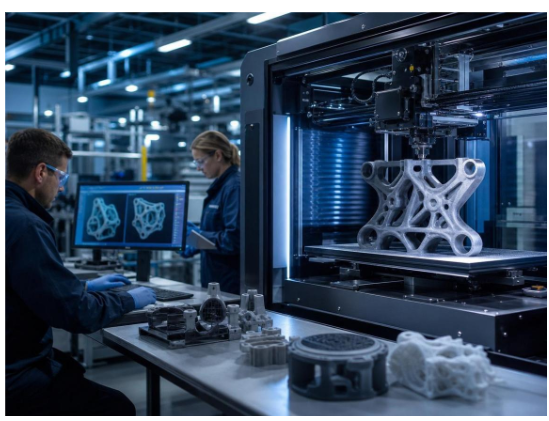
How 3D Printing Helps Manufacturers Produce Complex Parts and Reduce Tooling Costs
Manufacturers across aerospace, automotive, medical, defense, and industrial sectors are constantly looking for ways to produce complex components faster, reduce production costs, and improve design flexibility.
Traditional manufacturing methods such as machining, injection molding, casting, and forging remain essential for many applications. However, they often require expensive tooling, dedicated fixtures, multiple production steps, and long development cycles.
Industrial 3D printing is changing this approach by allowing manufacturers to create complex parts directly from digital designs without depending heavily on traditional tooling.
By using additive manufacturing technologies, companies can produce components layer by layer, reduce material waste, shorten development timelines, and lower the cost of manufacturing customized or low-volume parts.
The ability of 3D printing to reduce tooling costs has become one of the biggest advantages for manufacturers adopting Industry 4.0 production strategies.
Table of Contents
Why Tooling Costs Are a Challenge in Traditional Manufacturing
Tooling is often one of the largest investments required before production begins.
Traditional manufacturing may require:
- Injection molds
- Casting patterns
- Machining fixtures
- Dies
- Jigs
- Specialized production equipment
Creating these tools requires:
- Engineering design
- Tool manufacturing
- Testing and validation
- Modifications
- Final production approval
For high-volume production, tooling costs can be justified because the investment is distributed across thousands or millions of parts.
However, tooling becomes challenging for:
- Prototypes
- Customized products
- Low-volume production
- Complex geometries
- Frequent design changes
This is where additive manufacturing provides significant advantages.
How 3D Printing Reduces Tooling Costs
1. Manufacturing Directly From Digital Designs
One of the biggest advantages of 3D printing is the ability to manufacture parts directly from CAD files.
The process eliminates the need for:
- Molds
- Dies
- Specialized tooling
- Long setup processes
The workflow becomes:
- Create digital CAD model
- Prepare the printing file
- Produce the component
- Test and validate
Design changes can be implemented by modifying the digital file rather than creating new tooling.
This significantly reduces development costs and production delays.
2. Faster Prototyping Without Expensive Tooling
Product development often requires multiple prototype iterations.
Traditional prototyping may involve:
- Machined prototypes
- Temporary tooling
- Outsourced manufacturing
- Long waiting periods
Industrial 3D printing allows engineers to produce prototypes quickly and test different designs before committing to expensive production tooling.
Benefits include:
- Faster design validation
- Lower prototype costs
- Reduced engineering risk
- More design iterations
This is especially valuable in aerospace and automotive industries, where component optimization requires extensive testing.
3. Producing Complex Geometries That Traditional Methods Cannot Easily Manufacture
Traditional manufacturing processes often have limitations based on:
- Tool accessibility
- Machining limitations
- Mold design restrictions
- Assembly requirements
3D printing enables manufacturers to create complex geometries such as:
- Internal channels
- Lightweight lattice structures
- Topology-optimized components
- Integrated assemblies
- Organic shapes
These designs can improve:
- Weight reduction
- Performance
- Thermal management
- Material efficiency
4. Reducing Part Count Through Design Consolidation
Traditional manufacturing often requires multiple components assembled together.
A complex assembly may involve:
- Machined parts
- Fasteners
- Welding
- Additional assembly processes
3D printing enables part consolidation by creating a single integrated component.
Benefits include:
- Reduced assembly time
- Fewer production steps
- Lower inventory requirements
- Improved reliability
For aerospace applications, reducing the number of components can also reduce overall aircraft weight.
5. Lower Tooling Costs for Low-Volume Production
Many industries produce specialized components in limited quantities.
Examples include:
- Aerospace replacement parts
- Medical devices
- Defense components
- Industrial equipment parts
Creating traditional tooling for small production runs may not be economically practical.
3D printing provides a cost-effective alternative because manufacturers can produce parts directly without major tooling investment.
This makes additive manufacturing valuable for:
- Customized production
- Spare parts
- Limited production runs
- On-demand manufacturing
6. Digital Inventory Instead of Physical Inventory
Traditional manufacturing often requires companies to maintain large inventories of spare parts.
This creates costs related to:
- Storage
- Inventory management
- Obsolete parts
- Supply chain delays
Digital manufacturing allows companies to store part designs digitally and produce components when required.
Benefits include:
- Reduced inventory costs
- Faster replacement production
- Improved supply chain flexibility
This approach supports modern Industry 4.0 manufacturing strategies.
How 3D Printing Enables Complex Part Manufacturing
Different additive manufacturing technologies support different applications.
Metal 3D Printing for Complex Components
Metal additive manufacturing enables production of high-performance components using materials such as:
- Titanium
- Stainless steel
- Aluminium alloys
- Inconel
- Tool steel
Applications include:
- Aerospace brackets
- Engine components
- Medical implants
- Industrial tooling
Technologies include:
Metal Powder Bed Fusion
Suitable for:
- High-precision parts
- Complex geometries
- Lightweight structures
Electron Beam Melting (EBM)
Suitable for:
- Titanium components
- Aerospace applications
- Medical implants
Wire Arc Additive Manufacturing (WAAM)
Suitable for:
- Large metal components
- Heavy engineering parts
- Aerospace structures
WAAM provides high deposition rates and large build capability.
Polymer 3D Printing for Complex Parts
Polymer additive manufacturing is widely used for:
- Functional prototypes
- Manufacturing aids
- Fixtures
- Lightweight components
Technologies include:
SLA
Best for:
- Detailed prototypes
- Smooth surfaces
- Visual validation
SLS
Best for:
- Strong functional parts
- Complex assemblies
- Engineering prototypes
FDM
Best for:
- Large prototypes
- Production tools
- Cost-effective components
Industrial Applications Where 3D Printing Reduces Tooling Costs
Aerospace Manufacturing
Aerospace companies use additive manufacturing for:
- Lightweight structures
- Replacement components
- Prototypes
- Production parts
Benefits:
- Reduced tooling requirements
- Lower material waste
- Faster development
Automotive Manufacturing
Automotive manufacturers use 3D printing for:
- Prototype components
- Assembly fixtures
- Production tools
- Performance parts
Benefits:
- Faster product development
- Reduced tooling investment
- Improved design flexibility
Medical Manufacturing
Medical companies use additive manufacturing for:
- Customized implants
- Surgical tools
- Anatomical models
Benefits:
- Patient-specific production
- Complex designs
- Reduced manufacturing limitations
Industrial Equipment Manufacturing
Industrial manufacturers use 3D printing for:
- Machine components
- Jigs
- Fixtures
- Replacement parts
Benefits:
- Reduced downtime
- Faster production support
- Lower inventory requirements
3D Printing vs Traditional Tooling: Cost Comparison
Factor | Traditional Manufacturing | 3D Printing |
Tooling Requirement | Often required | Minimal or none |
Design Changes | Expensive | Digital modification |
Prototype Development | Longer | Faster |
Low Volume Production | Higher setup cost | More economical |
Complex Geometry | Limited | Excellent capability |
Customization | Difficult | Easy |
Inventory Requirement | Physical stock | Digital inventory |
Factors to Consider Before Implementing 3D Printing
While additive manufacturing provides major advantages, manufacturers should evaluate:
Production Requirements
Consider:
- Part quantity
- Required strength
- Production timeline
Material Requirements
Evaluate:
- Mechanical properties
- Temperature resistance
- Environmental conditions
Post-Processing Needs
Some parts may require:
- CNC machining
- Heat treatment
- Surface finishing
- Inspection
Quality Requirements
Critical industries may require:
- Process monitoring
- Material certification
- Testing procedures
The Role of Additive Manufacturing in Industry 4.0
3D printing is a key technology supporting digital manufacturing.
It enables:
- Digital production workflows
- Faster product development
- Distributed manufacturing
- Reduced supply chain dependency
- Data-driven production
By connecting design, production, and quality processes, additive manufacturing helps manufacturers create more flexible production environments.
Conclusion
3D printing is helping manufacturers overcome traditional production limitations by enabling complex part manufacturing, reducing tooling requirements, and accelerating product development.
By removing the need for expensive molds and enabling direct digital production, additive manufacturing provides greater flexibility for prototypes, customized components, and low-volume production.
The right combination of 3D printing technology, materials, software, and post-processing allows manufacturers to reduce costs while improving innovation and production efficiency.
Lodestar 3D helps companies implement industrial additive manufacturing solutions with advanced 3D printers, materials, and technical expertise for modern manufacturing applications.
FAQ's
1. How does 3D printing reduce tooling costs?
3D printing reduces tooling costs by manufacturing parts directly from digital designs without requiring molds, dies, or specialized production tooling.
2. Can 3D printing replace traditional manufacturing tools?
3D printing can replace some tooling requirements, especially for prototypes, low-volume production, fixtures, and customized components. However, traditional tooling remains valuable for high-volume manufacturing.
3. What complex parts can be made using 3D printing?
3D printing can produce lightweight structures, internal channels, lattice designs, consolidated assemblies, aerospace components, medical parts, and customized industrial components.
4. Is 3D printing cheaper than traditional manufacturing?
The cost advantage depends on the application. 3D printing is often more economical for complex, customized, and low-volume parts, while traditional manufacturing may be better for very high-volume production.
5. Which industries benefit most from 3D printing?
Aerospace, automotive, medical, defense, energy, and industrial manufacturing industries benefit from reduced tooling costs and improved design flexibility.