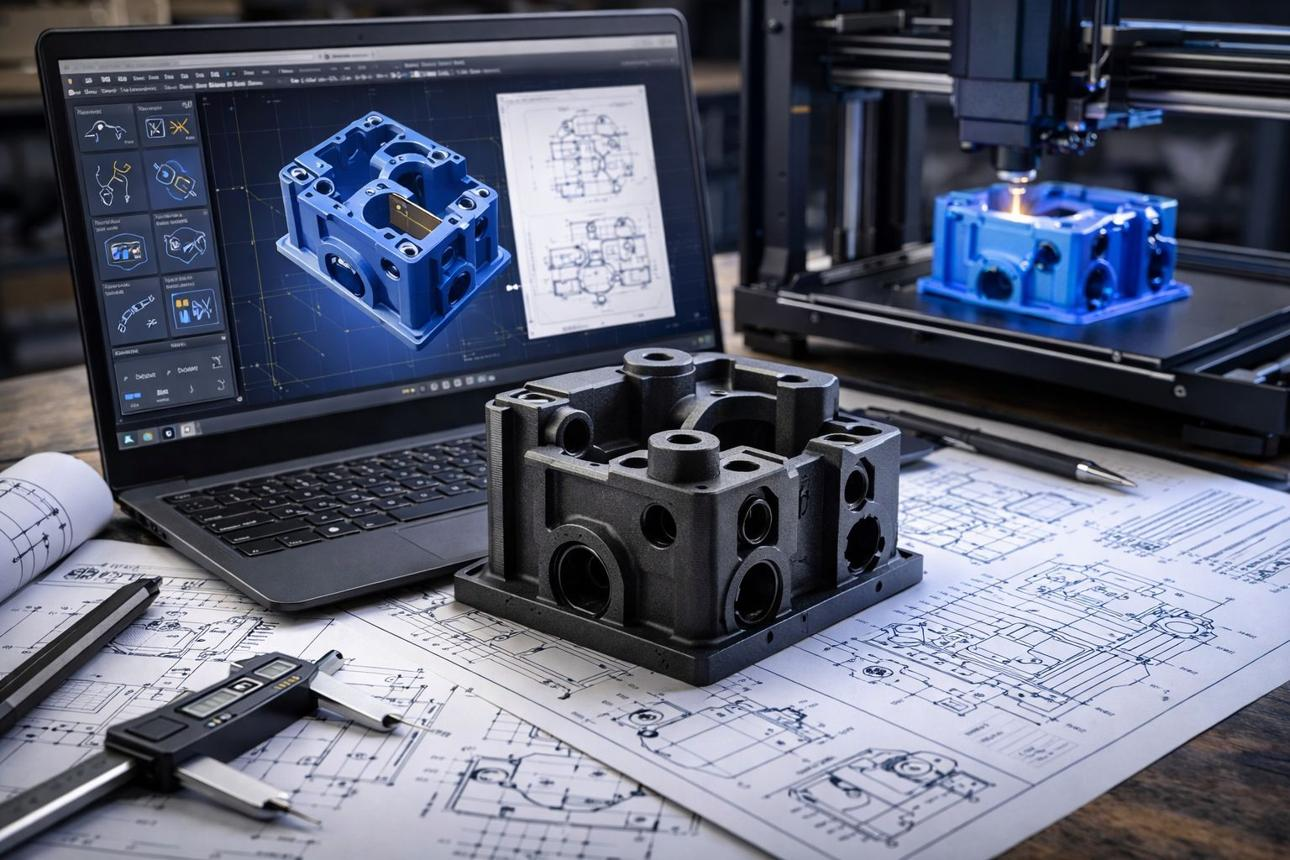
Industrial 3D Printing for Prototypes: From Design to Functional Part

Industrial 3D printing process from CAD design to functional prototype production

Product development has traditionally involved multiple stages of design, tooling, machining, testing, and manufacturing preparation. While these processes remain important, they can create long development cycles, especially when engineers need multiple design iterations before final production.

Industrial 3D printing for prototypes has changed the way manufacturers approach product development by enabling companies to move directly from digital design files to physical components.

Instead of waiting weeks for tooling or outsourced manufacturing, engineers can create prototypes quickly, test designs, identify improvements, and move closer to production.

Today, industries such as aerospace, automotive, medical, defense, electronics, and industrial equipment use additive manufacturing to produce everything from visual prototypes to fully functional engineering parts.

The journey from design concept to functional component involves much more than simply printing a part. It requires the right technology selection, material choice, design optimization, post-processing, and validation.

This article explains how industrial 3D printing transforms an idea into a functional prototype.

Table of Contents

What Is Industrial 3D Printing for Prototypes?

Industrial 3D printing is an advanced manufacturing approach that creates parts layer by layer from a digital CAD model.

Unlike traditional manufacturing methods that remove material or require tooling, additive manufacturing builds components directly from digital data.

Industrial 3D printers are designed for:

  • High accuracy
  • Repeatable production
  • Engineering-grade materials
  • Functional testing
  • Complex geometries
  • Professional manufacturing workflows

Depending on the application, manufacturers may use different technologies:

Polymer 3D Printing Technologies

  • SLA (Stereolithography)
  • SLS (Selective Laser Sintering)
  • FDM (Fused Deposition Modeling)
  • MJF (Multi Jet Fusion)

Metal Additive Manufacturing Technologies

  • Metal Powder Bed Fusion
  • DMLS
  • SLM
  • EBM
  • WAAM
  • Directed Energy Deposition

The right technology depends on whether the prototype requires appearance validation, mechanical testing, heat resistance, durability, or production-level performance.

Why Manufacturers Use 3D Printing for Prototyping

The Industrial 3D Printing Prototype Workflow

The journey from design to functional part involves several important stages.

Step 1: Digital Design and CAD Preparation

Every 3D printed prototype begins with a digital model.

Engineers create CAD designs using software such as:

  • SolidWorks
  • CATIA
  • Siemens NX
  • Autodesk Inventor
  • Fusion 360

During this stage, designers evaluate:

  • Component geometry
  • Assembly requirements
  • Material needs
  • Manufacturing limitations

For additive manufacturing, engineers can also redesign components specifically for 3D printing.

This process is known as:

Design for Additive Manufacturing (DfAM)

DfAM focuses on creating parts that take advantage of additive manufacturing capabilities.

Step 2: Selecting the Right 3D Printing Technology

Choosing the correct technology is one of the most important decisions.

Different prototypes require different approaches.

SLA for High-Detail Prototypes

SLA is suitable when manufacturers need:

  • Smooth surface finish
  • Fine details
  • Accurate appearance models
  • Transparent parts

Applications:

  • Product design models
  • Medical prototypes
  • Consumer products
  • Visual validation

SLS for Functional Polymer Parts

SLS is ideal for:

  • Strong prototypes
  • Mechanical testing
  • Complex assemblies
  • Production-like polymer parts

Applications:

  • Automotive components
  • Industrial housings
  • Functional brackets
  • Engineering prototypes

FDM for Cost-Effective Prototypes

Industrial FDM is useful for:

  • Large prototypes
  • Manufacturing aids
  • Fixtures
  • Assembly tools

Advantages:

  • Lower material cost
  • Wide material options
  • Easy workflow

Metal 3D Printing for Functional Metal Parts

Metal additive manufacturing is used when prototypes require production-level materials.

Applications include:

  • Aerospace components
  • Automotive performance parts
  • Medical implants
  • Industrial tooling

Step 3: Material Selection

Material selection directly affects prototype performance.

Engineers should consider:

  • Strength
  • Flexibility
  • Temperature resistance
  • Chemical resistance
  • Weight
  • Surface requirements

Polymer Materials

Common materials include:

  • Nylon
  • ABS
  • TPU
  • Engineering resins
  • Carbon fiber reinforced polymers

Used for:

  • Functional prototypes
  • Housings
  • Fixtures
  • Consumer products

Metal Materials

Common metals include:

  • Titanium
  • Stainless steel
  • Aluminium alloys
  • Inconel
  • Tool steel

Used for:

  • Aerospace parts
  • Industrial components
  • High-performance applications

Step 4: Printing the Prototype

Once the design and material are finalized, the CAD model is prepared for printing.

The process includes:

  • File preparation
  • Build orientation
  • Support generation
  • Printing parameters
  • Machine setup

Industrial printers provide greater control over:

  • Accuracy
  • Repeatability
  • Material performance
  • Production consistency

Step 5: Post-Processing and Finishing

A printed part is often not the final component immediately after production.

Post-processing improves:

  • Surface quality
  • Mechanical performance
  • Dimensional accuracy
  • Appearance

Common processes include:

Polymer Part Finishing

  • Washing
  • UV curing
  • Sanding
  • Vapor polishing
  • Painting

Metal Part Finishing

  • Support removal
  • Heat treatment
  • CNC machining
  • Surface finishing
  • Inspection

Step 6: Testing and Validation

The purpose of a functional prototype is to test real-world performance.

Testing may include:

  • Assembly testing
  • Mechanical testing
  • Thermal testing
  • Load testing
  • Fit validation
  • User evaluation

Engineers use prototype feedback to improve:

  • Design
  • Material selection
  • Manufacturing approach

Industrial Applications of Prototype 3D Printing

Aerospace

Aerospace manufacturers use 3D printing for:

  • Lightweight structures
  • Aircraft components
  • Tooling
  • Functional prototypes

Benefits:

  • Reduced weight
  • Faster development
  • Lower material waste

Automotive

Applications include:

  • Interior components
  • Engine prototypes
  • Assembly tools
  • Performance parts

Benefits:

  • Faster vehicle development
  • Reduced tooling costs
  • Design flexibility

Medical

Applications include:

  • Anatomical models
  • Surgical planning models
  • Medical devices
  • Custom components

Benefits:

  • Patient-specific designs
  • High accuracy
  • Faster validation

Industrial Manufacturing

Applications include:

  • Jigs
  • Fixtures
  • Machine components
  • Production aids

Benefits:

  • Reduced downtime
  • Faster tooling
  • Improved workflow efficiency

From Prototype to Production: Using 3D Printing Beyond Testing

Modern industrial 3D printing is not limited to prototypes.

Many companies use additive manufacturing for:

  • Low-volume production
  • Customized components
  • Replacement parts
  • Manufacturing tools
  • End-use products

The same digital workflow used for prototyping can support production manufacturing.

This creates a smoother transition from design validation to final manufacturing.

Schedule A Call

+91 990-000-3300

Benefits of Industrial 3D Printing in Product Development

Faster Innovation

Companies can test ideas quickly and make improvements faster.

Lower Risk

Early prototypes identify problems before expensive production investment.

Better Design Freedom

Engineers can explore designs that traditional manufacturing limits.

Reduced Supply Chain Dependency

Digital manufacturing allows faster production without relying entirely on external suppliers.

Improved Product Performance

Optimized designs can improve:

  • Weight
  • Strength
  • Efficiency
  • Functionality

How to Select an Industrial 3D Printer for Prototyping

Manufacturers should evaluate:

Application Requirements

  • Visual model or functional part?
  • Prototype testing requirements?
  • Production possibility?

Material Requirements

  • Polymer or metal?
  • Mechanical performance?
  • Environmental conditions?

Accuracy Requirements

  • Tolerance needs
  • Surface finish
  • Feature size

Production Goals

  • Number of prototypes
  • Future production requirements
  • Workflow integration

Total Cost

Consider:

  • Machine investment
  • Materials
  • Maintenance
  • Software
  • Post-processing
  • Operator training

Conclusion

Industrial 3D printing has transformed the product development process by allowing manufacturers to move from digital design to functional prototypes faster and more efficiently.

From concept validation and engineering testing to production-ready components, additive manufacturing provides flexibility that traditional methods cannot always achieve.

The right combination of technology, materials, software, and post-processing allows companies to reduce development cycles, improve designs, and accelerate innovation.

Lodestar 3D helps manufacturers adopt industrial 3D printing solutions by providing advanced printers, materials, software, and technical expertise for modern additive manufacturing workflows.

FAQ's

Industrial 3D printing for prototypes is the use of professional additive manufacturing systems to create accurate, functional, and production-ready prototype components from digital CAD designs.

Yes. Depending on the technology and material, 3D printed prototypes can be tested for mechanical performance, assembly fit, durability, thermal behavior, and real-world operation.

The best technology depends on the application. SLA is suitable for detailed prototypes, SLS for functional polymer parts, FDM for large affordable prototypes, and metal 3D printing for high-performance components.

The timeline depends on part size, technology, material, and post-processing requirements. Some prototypes can be produced within hours, while larger or complex components may require several days.

3D printing complements traditional manufacturing by reducing development time, enabling complex designs, and supporting low-volume production. It is often combined with machining and other manufacturing methods.

    Agree to our terms and conditions.
    Your information will be securely sent to and stored in Google Sheets for the purpose of processing your form submission.