

What is Wire Arc Additive Manufacturing? A Complete Beginner’s Guide
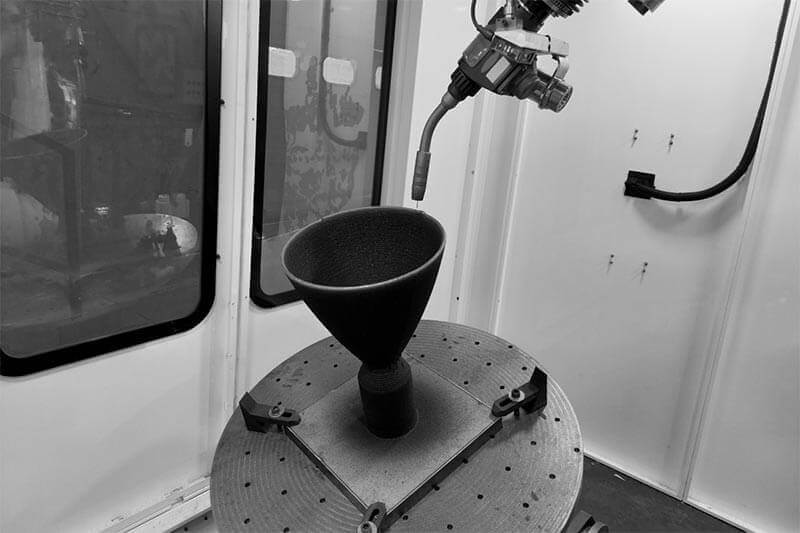
Manufacturing teams are being pushed to produce larger metal parts faster, reduce material waste, lower tooling dependency, and improve design flexibility without compromising mechanical performance. Wire Arc Additive Manufacturing addresses these challenges by combining welding-based metal deposition with digital manufacturing principles.
Also known as WAAM, this process builds metallic parts layer by layer by feeding metal wire into an electric arc heat source. The wire melts, deposits on a substrate, solidifies, and gradually forms a near-net-shape component.
For industries such as aerospace, automotive, defense, energy, heavy engineering, and R&D, WAAM offers a practical route to large-format metal additive manufacturing. It is especially useful where powder-based metal 3D printing may be too expensive, too slow, or limited by build chamber size.
Lodestar 3D supports Indian manufacturers with industrial additive manufacturing technologies, materials, software, surface finishing solutions, and expert technical guidance. With headquarters in Jayanagar, Bengaluru, and pan-India operations, Lodestar 3D helps organizations evaluate, implement, and scale the right additive manufacturing ecosystem for their production needs.
[Internal Link: Product Page for Metal Additive Manufacturing]
Table of Contents
The Challenge of Large Metal Part Manufacturing
Conventional manufacturing processes such as casting, forging, machining, and fabrication remain critical for industrial production. However, they are not always efficient for large, complex, customized, or low-volume metal components.
For many engineering teams, the challenge is not whether traditional manufacturing works. The challenge is whether it works fast enough, cost-effectively enough, and flexibly enough for modern manufacturing requirements.
Common pain points in traditional metal manufacturing
Large metal part production often involves:
- Expensive dies, molds, fixtures, or casting patterns
- Long lead times for tooling and supplier coordination
- High buy-to-fly ratios in aerospace and defense components
- Significant material waste during subtractive machining
- Multi-part assemblies that require welding, fastening, and inspection
- Limited design freedom for internal channels and topology-optimized structures
- Difficulty producing one-off, replacement, or customized components
- Supply chain delays for critical spare parts
These challenges become more serious when companies need low-volume production, quick design iterations, localized manufacturing, or large metal parts with complex geometries.
This is where Wire Arc Additive Manufacturing becomes important.
What is Wire Arc Additive Manufacturing?
Wire Arc Additive Manufacturing is a metal additive manufacturing process that uses a continuously fed metallic wire as the raw material and an electric arc as the heat source.
The process works on a simple principle:
A metal wire is fed into a welding torch. The electric arc melts the wire. The molten metal is deposited onto a base plate or previous layer. The material solidifies. The machine repeats this layer by layer until the required component geometry is created.
In basic terms, WAAM is similar to robotic welding, but instead of joining two parts together, the system deposits material to build a new part.
Simple definition
Wire Arc Additive Manufacturing is a layer-by-layer metal deposition process where a continuously fed metal wire is melted using an electric arc and deposited to create large metallic components.
Why WAAM is considered additive manufacturing
It is called additive manufacturing because the component is created by adding material only where required. This is different from subtractive manufacturing, where material is removed from a larger block through machining.
In WAAM, raw material is used more efficiently. This helps reduce waste, improve material utilization, and support more sustainable production.
How Wire Arc Additive Manufacturing Works
WAAM combines elements of welding, robotics, CAD/CAM, process control, and metallurgy.
A typical WAAM system includes:
- Metal wire feedstock
- Arc welding power source
- Welding torch or deposition head
- Robotic arm, gantry, or multi-axis motion system
- Build platform or substrate
- Shielding gas system
- Process monitoring sensors
- Toolpath planning software
- Post-processing and finishing systems
Step-by-step WAAM process
1. Digital design preparation
The process begins with a CAD model of the part. Engineers design the component based on functional, structural, and manufacturing requirements.
The design may include:
- Topology-optimized geometry
- Reduced assembly features
- Ribbed or reinforced sections
- Lightweight structural areas
- Large near-net-shape volumes
- Repair or rebuild regions
The CAD model is then prepared for additive manufacturing using slicing and toolpath planning software.
2. Material selection
The metallic wire is selected based on application requirements. Common WAAM materials include stainless steel, carbon steel, aluminum alloys, titanium alloys, nickel alloys, and other weldable metals.
Material selection depends on:
- Strength requirements
- Corrosion resistance
- Heat resistance
- Fatigue behavior
- Weldability
- Industry standards
- Final operating environment
3. Wire feeding and arc generation
The metallic wire is continuously fed into the arc zone. The electric arc generates enough heat to melt the wire.
Depending on the system, WAAM may use welding-based processes such as:
- Gas Metal Arc Welding
- Gas Tungsten Arc Welding
- Plasma Arc Welding
- Cold Metal Transfer
The choice of arc process affects deposition rate, heat input, bead geometry, surface quality, and metallurgical behavior.
4. Layer-by-layer deposition
The molten metal is deposited onto the substrate or previous layer. Each new layer bonds metallurgically with the layer below it.
The motion system controls the deposition path. Robotic WAAM systems may use a robotic arm, positioner, slider, gantry, or multi-axis setup to build larger and more complex components.
5. Thermal control and monitoring
Heat management is critical in WAAM. Since the process uses an electric arc, thermal cycles affect microstructure, distortion, residual stress, and final part quality.
Manufacturers may monitor:
- Arc current
- Arc voltage
- Wire feed rate
- Travel speed
- Interpass temperature
- Bead height
- Cooling rate
- Shielding gas behavior
- Layer geometry
Advanced systems may use cameras, sensors, and software to improve consistency and reduce defects.
6. Post-processing
WAAM produces near-net-shape parts. This means the printed part is close to the final required shape but usually still requires some finishing.
Post-processing may include:
- CNC machining
- Heat treatment
- Stress relief
- Surface finishing
- Inspection
- Non-destructive testing
- Dimensional verification
Compared to many conventional methods, WAAM can reduce the number of production and post-processing steps because the part is built close to its final geometry.
[Internal Link: Case Study]

How Wire Arc Additive Manufacturing is Revolutionizing Metal Manufacturing
Wire Arc Additive Manufacturing is gaining attention because it solves a specific industrial problem: producing large metal parts without the high waste, tooling cost, and lead time of conventional manufacturing.
It is not intended to replace every process. Instead, WAAM is most valuable where large-format metal deposition, material efficiency, and design flexibility matter.
WAAM for aerospace manufacturing
Aerospace components often involve expensive materials such as titanium, aluminum, and nickel alloys. Conventional machining from solid billets can lead to high material waste.
WAAM can reduce material waste by depositing metal closer to the required shape. This is particularly valuable for:
- Structural brackets
- Large ribs and frames
- Aircraft tooling
- Repair applications
- Low-volume flight hardware development
- Near-net-shape titanium components
The ability to produce large lightweight geometries makes WAAM relevant for aerospace R&D and production engineering.
WAAM for automotive manufacturing
Automotive manufacturers can use WAAM for tooling, fixtures, prototypes, and performance parts. The technology is useful where fast design iteration and low-volume production are required.
Typical applications include:
- Prototype chassis components
- Custom tooling
- Welding fixtures
- Forming tools
- Lightweight structural parts
- Motorsport components
- Large metal prototypes
For EV platforms and advanced mobility programs, WAAM can support faster development cycles and functional design validation.
WAAM for defense manufacturing
Defense manufacturing often requires low-volume, mission-critical, and difficult-to-source components. WAAM supports localized production and repair of large metallic parts.
Potential defense applications include:
- Replacement components
- Vehicle structures
- Naval components
- Armored system parts
- Repair of high-value metal assets
- Large-scale prototypes
- Supply chain risk reduction
The ability to manufacture closer to the point of need can improve operational resilience.
WAAM for energy and heavy engineering
WAAM is well suited for large components in energy, oil and gas, heavy equipment, and industrial machinery.
Applications may include:
- Pressure-related components
- Turbine and pump parts
- Large shafts and housings
- Repair of worn components
- Tooling for heavy fabrication
- Large custom metal structures
For large-format parts, WAAM can be more practical than powder-bed metal additive manufacturing because it is not restricted by small build chamber dimensions.
Technical Advantages: Why Choose Wire Arc Additive Manufacturing for Industrial Scale?
Wire Arc Additive Manufacturing offers several advantages for industrial production. These benefits come from its use of wire feedstock, arc heat, robotic motion, and near-net-shape deposition.
Low equipment cost
The investment required for Wire Arc Additive Manufacturing is generally lower than many other directed energy deposition technologies. WAAM uses welding-based hardware and wire feedstock, making it more accessible for industrial-scale metal deposition.
This makes WAAM attractive for manufacturers evaluating additive manufacturing for large metal parts without immediately moving to high-cost powder-based systems.
Fast production
WAAM offers high deposition rates compared to many other additive manufacturing processes. This makes it suitable for producing large-volume components faster.
For large metal parts, the speed advantage can be significant because the process deposits metal wire continuously rather than spreading and melting thin layers of metal powder.
Low part production cost
WAAM can reduce part production costs by improving raw material efficiency, reducing tooling needs, and minimizing waste.
The cost advantage is especially relevant when:
- Raw material is expensive
- Conventional machining removes large amounts of material
- Tooling cost is high
- Production volume is low or medium
- Lead time reduction has commercial value
Short post-processing time
WAAM parts are near-net-shape components. This means they require finishing, but often less total processing compared with routes that involve casting, rough machining, welding subassemblies, and final finishing.
The exact post-processing depends on tolerance, surface roughness, mechanical property requirements, and certification needs.
Low material waste
In conventional subtractive manufacturing, a large billet or block may be machined down to the final component. This creates chips and scrap.
WAAM deposits material only where it is needed. This improves raw material utilization and supports more sustainable manufacturing.
Easy assembly through part consolidation
Many conventionally manufactured components are made from multiple subcomponents that are welded, bolted, or assembled together.
WAAM enables engineers to manufacture consolidated parts as one piece. This can reduce:
- Number of components
- Assembly steps
- Welding operations
- Fasteners
- Inspection points
- Failure-prone joints
Part consolidation can improve rigidity and simplify production.
Manufacturing complex geometries at once
The layer-by-layer method allows WAAM to create complex geometries that may be difficult or expensive with conventional manufacturing.
This includes:
- Curved walls
- Reinforced structures
- Variable cross-sections
- Large custom forms
- Repair build-ups
- Topology-optimized shapes
While WAAM does have geometric limitations, it offers more design freedom than many traditional metal fabrication routes.
Eco-friendly manufacturing approach
WAAM supports lower material consumption and reduced waste. Because it uses wire feedstock efficiently, it can contribute to more environmentally sustainable manufacturing.
Sustainability benefits may include:
- Lower scrap generation
- Improved material efficiency
- Reduced need for tooling
- Longer life through repair and refurbishment
- Potential for localized production
One-piece rigid production
In conventional manufacturing, large components are often built from multiple sub-parts. Each joint can introduce structural, quality, or inspection concerns.
WAAM can create certain parts as a single component. This supports more rigid construction and may improve mechanical reliability when designed and processed correctly.
Reducing the number of production processes
WAAM can reduce the number of process steps required to create a finished part.
A conventional route may include forging, rough machining, welding, stress relieving, inspection, and final machining. WAAM can create a near-net-shape component first, reducing the amount of downstream machining and assembly required.
Freedom of design
WAAM enables more freedom for large metal component design. Engineers can explore generative design, topology optimization, and function-driven geometry.
This is valuable for Industry 4.0 manufacturing because design, simulation, process planning, deposition, inspection, and feedback can be integrated into a digital workflow.
High-volume part manufacturing
With fast deposition rates and robotic peripherals such as positioners, sliders, gantries, and multi-axis systems, WAAM can support the production of large-volume components.
Robotic WAAM also makes it easier to expand the build envelope compared with many enclosed metal 3D printing systems.
Wire Arc Additive Manufacturing vs Other Metal Additive Manufacturing Processes
WAAM is one of several metal additive manufacturing processes. It should be selected based on part size, tolerance, material, surface quality, production volume, and business case.
WAAM vs Metal Powder Bed Fusion
Metal Powder Bed Fusion, including MPBF, is highly suitable for small to medium metal parts requiring fine detail, complex internal channels, and tight feature resolution.
WAAM is better suited for larger metal components where high deposition rate and lower material cost are more important than fine surface detail.
WAAM vs EBM
Electron Beam Melting is a powder-bed process often used for high-performance metal parts, especially in aerospace and medical applications. EBM operates in a vacuum and is suitable for specific material systems.
WAAM offers larger build possibilities and lower-cost wire feedstock, but it generally requires more machining and surface finishing.
WAAM vs CNC machining
CNC machining delivers excellent dimensional accuracy and surface finish. However, it removes material from a block.
WAAM builds near-net-shape parts first. CNC machining can then be used for final tolerances and surface finish. In many cases, WAAM and CNC are complementary rather than competing processes.
WAAM vs casting and forging
Casting and forging are strong choices for high-volume production. However, they often require tooling, dies, molds, and long development cycles.
WAAM is useful for low-volume, customized, repair, prototype, and large near-net-shape parts where tooling cost or lead time is a major barrier.
Implementation Roadmap: From Prototype to Mass Production
A successful WAAM implementation requires a structured roadmap. Buying equipment without process planning can lead to inconsistent results, poor adoption, and unclear ROI.
Step 1: Identify the right application
Not every part is suitable for WAAM. The best candidates usually have one or more of the following characteristics:
- Large metal geometry
- High material waste in machining
- Expensive tooling in conventional manufacturing
- Low to medium production volume
- Long procurement lead time
- Complex geometry
- Repair or rebuild requirement
- Opportunity for part consolidation
The first step is to identify parts where WAAM creates measurable technical or commercial value.
Step 2: Build the business case
The business case should compare WAAM with the current manufacturing route.
Key parameters include:
- Current part cost
- Material waste
- Lead time
- Tooling cost
- Machining time
- Assembly steps
- Supplier dependency
- Inspection requirements
- Post-processing needs
- Production volume
WAAM is strongest when it solves a real manufacturing pain point, not when it is adopted only as a new technology.
Step 3: Select technology and material
The correct system depends on part size, material, deposition rate, accuracy, and finishing requirements.
For some parts, WAAM may be ideal. For others, MPBF, EBM, SLS, SLA, or hybrid manufacturing may be better.
Lodestar 3D helps manufacturers evaluate the right additive manufacturing route based on technical and commercial requirements.
Step 4: Validate process parameters
WAAM quality depends on stable process parameters.
Important parameters include:
- Wire feed rate
- Travel speed
- Arc current
- Arc voltage
- Shielding gas flow
- Layer height
- Bead width
- Heat input
- Interpass temperature
- Deposition strategy
Parameter validation helps improve repeatability and part quality.
Step 5: Print, inspect, and test
Initial builds should be inspected for geometry, defects, mechanical behavior, and process consistency.
Testing may include:
- Dimensional inspection
- Metallurgical analysis
- Tensile testing
- Hardness testing
- Fatigue testing
- Non-destructive testing
- Surface roughness measurement
This stage converts WAAM from a concept into a controlled manufacturing process.
Step 6: Add finishing and machining
WAAM parts commonly require final machining or finishing. The process plan should include machining allowance, datum strategy, heat treatment, and surface treatment from the beginning.
This avoids production delays later.
Step 7: Scale into production
Once the process is validated, manufacturers can scale into repeat production, repair operations, or hybrid manufacturing workflows.
Scaling may involve:
- Robotic automation
- Gantry systems
- Positioners
- In-process monitoring
- Standard operating procedures
- Quality documentation
- Operator training
- Maintenance planning
[Internal Link: Contact for Quote]
Limitations of Wire Arc Additive Manufacturing
WAAM has strong industrial advantages, but it is not suitable for every application.
Surface finish
WAAM parts typically have rougher surfaces than powder-bed metal 3D printed parts. Final machining or finishing is usually required.
Dimensional accuracy
WAAM is suitable for near-net-shape production, not direct high-precision final geometry. Machining may be needed for critical tolerances.
Heat management
The arc process creates significant heat. Poor thermal control can lead to distortion, residual stress, or inconsistent microstructure.
Geometric limitations
WAAM can produce complex large structures, but it is not ideal for very fine features, small internal channels, or extremely intricate details.
Qualification requirements
For aerospace, defense, and medical applications, qualification and certification requirements must be planned carefully.
The right approach is not to treat WAAM as a universal replacement. It should be used where its advantages match the engineering requirement.
Wire Arc Additive Manufacturing and the Future of Digital Manufacturing
Wire Arc Additive Manufacturing gives industrial manufacturers a practical way to build large metal parts with improved material efficiency, faster production, lower tooling dependency, and greater design freedom.
For beginners, the concept is straightforward: WAAM melts metal wire with an electric arc and deposits it layer by layer. For advanced manufacturers, the opportunity is much larger. WAAM can support part consolidation, repair, hybrid manufacturing, localized production, and Industry 4.0 workflows.
The strongest results come when the technology is applied with proper engineering judgment. Material selection, process parameters, thermal control, finishing, inspection, and business case validation all matter.
Lodestar 3D helps manufacturers make this transition with industrial 3D printers, materials, software, surface finishing solutions, and expert technical support. With more than 15 years of experience in high-value capital equipment and partnerships with global OEMs, Lodestar 3D supports organizations from lab-scale exploration to production-ready additive manufacturing.
To evaluate whether Wire Arc Additive Manufacturing or another industrial additive manufacturing process is right for your application, consult Lodestar 3D’s technical experts.
Request a consultation or quote for your specific manufacturing requirement.
[Internal Link: Contact for Quote]
FAQ's
1. What is Wire Arc Additive Manufacturing used for?
Wire Arc Additive Manufacturing is used to produce large metal parts, near-net-shape components, repair structures, tooling, prototypes, and low-volume industrial parts. It is especially useful in aerospace, automotive, defense, energy, heavy engineering, and R&D applications.
2. Is WAAM the same as metal 3D printing?
WAAM is a type of metal 3D printing. It uses metal wire and an electric arc instead of metal powder and a laser or electron beam. It is best suited for large metal components where deposition speed and material efficiency are important.
3. What materials can be used in WAAM?
WAAM can process many weldable metals, including steel, stainless steel, aluminum alloys, titanium alloys, nickel alloys, and other engineering metals. The exact material choice depends on weldability, mechanical properties, and application requirements.
4. Does WAAM require post-processing?
Yes. WAAM produces near-net-shape parts, but final machining, heat treatment, stress relief, inspection, or surface finishing may be required depending on tolerance and performance requirements.
5. Is WAAM suitable for mass production?
WAAM can support production, especially for large, low-volume, customized, or high-value metal components. For very high-volume small parts, conventional manufacturing may still be more suitable. The decision depends on cost, part size, geometry, material, and production volume.