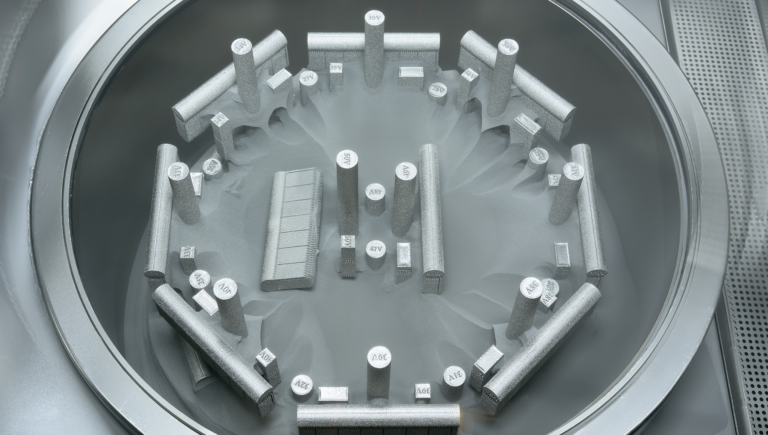
Industrial manufacturers are continuously looking for ways to reduce production time, improve material efficiency, lower manufacturing costs, and produce more complex components. Two technologies that play a major role in modern manufacturing are metal 3D printing and CNC machining.
CNC machining has been the foundation of precision manufacturing for decades. It provides excellent accuracy, surface finish, and repeatability across industries such as aerospace, automotive, medical, defense, and engineering.
Metal 3D printing, also known as metal additive manufacturing, represents a newer approach. Instead of removing material from a solid block, it builds components layer by layer using metal powder or wire-based feedstock. This enables manufacturers to produce complex geometries, lightweight structures, and near-net-shape components.
The question is not simply whether metal 3D printing is better than CNC machining. The right choice depends on the application, production volume, material requirements, design complexity, tolerances, and business objectives.
This guide compares metal 3D printing and CNC machining to help manufacturers understand where each technology delivers the greatest value.
Table of Contents
Understanding Metal 3D Printing and CNC Machining
What Is Metal 3D Printing?
Metal 3D printing is an additive manufacturing process where components are created by adding material layer by layer based on a digital CAD model.
Depending on the technology, metal 3D printing may use:
Metal Powder Bed Fusion (MPBF)
Direct Metal Laser Sintering (DMLS)
Selective Laser Melting (SLM)
Electron Beam Melting (EBM)
Wire Arc Additive Manufacturing (WAAM)
Directed Energy Deposition (DED)
The process enables manufacturers to create parts that may be difficult or impossible to manufacture using traditional methods.
Key advantages include:
Complex geometry production
Lightweight design opportunities
Reduced material waste
Part consolidation
Faster design iteration
Digital manufacturing workflow
Metal 3D printing is especially valuable for low-volume production, customized components, aerospace structures, medical implants, tooling inserts, and high-performance engineering parts.
What Is CNC Machining?
CNC machining is a subtractive manufacturing process where material is removed from a solid workpiece using computer-controlled cutting tools.
Common CNC processes include:
Milling
Turning
Drilling
Grinding
Multi-axis machining
CNC machines can produce highly accurate components from materials such as:
Aluminum
Stainless steel
Titanium
Tool steel
Inconel
Brass
Engineering plastics
CNC machining remains one of the most reliable manufacturing methods because of its excellent dimensional accuracy, surface finish, and ability to work with a wide range of materials.
Metal 3D Printing vs CNC Machining: Key Differences
Material Efficiency: Metal 3D Printing vs CNC Machining
Material utilization is an important consideration, especially when using expensive metals such as titanium and nickel alloys.
CNC Machining Material Usage
CNC machining starts with a larger block of material and removes unwanted sections.
This can create significant waste, especially when producing complex parts.
For example:
A component requiring 5 kg of final material may start from a 50 kg metal billet depending on geometry.
Metal 3D Printing Material Usage
Metal additive manufacturing deposits material only where required.
Benefits include:
Reduced scrap
Better raw material utilization
Lower buy-to-fly ratio
More sustainable manufacturing
This is particularly valuable in aerospace, where titanium waste can represent a significant cost.
Production Speed Comparison
Speed depends heavily on part size, complexity, machine capability, and post-processing requirements.
When Metal 3D Printing Is Faster
Metal 3D printing can reduce lead times when:
Tooling is expensive
Parts are customized
Production quantities are low
Complex assemblies need consolidation
Design changes are frequent
A part that requires weeks of tooling development may be produced directly from a CAD file.
When CNC Machining Is Faster
CNC machining is often faster for:
Simple geometries
High-volume production
Parts requiring excellent surface finish
Components with standard designs
For mature production parts, CNC machining remains highly efficient.
Schedule A Call
+91 990-000-3300
Accuracy and Surface Finish
CNC Machining
CNC machining remains superior for:
Tight tolerances
Precision surfaces
Final dimensional accuracy
High-quality finishes
It is commonly used for aerospace, medical, and automotive components requiring strict specifications.
Metal 3D Printing
Metal 3D printing accuracy depends on:
Printing technology
Material
Machine calibration
Part orientation
Process parameters
Post-processing
Most metal 3D printed parts require:
CNC machining
Heat treatment
Surface finishing
Inspection
A common industrial workflow is combining both technologies.
Hybrid Manufacturing: Combining Metal 3D Printing and CNC Machining
Many manufacturers are not choosing between additive and subtractive manufacturing. Instead, they are combining both.
A hybrid workflow may include:
Metal 3D printing creates a near-net-shape component.
Heat treatment improves mechanical properties.
CNC machining achieves final tolerances.
Surface finishing improves appearance and performance.
This approach provides:
Reduced material waste
Lower machining time
Better design flexibility
Precision finishing
Hybrid manufacturing is becoming an important part of Industry 4.0 production strategies.
Applications Where Metal 3D Printing Is Better
Metal additive manufacturing is especially useful for:
Aerospace
Applications include:
Lightweight structural parts
Titanium components
Aircraft brackets
Engine-related parts
Complex cooling structures
Benefits:
Weight reduction
Material savings
Design optimization
Medical
Applications include:
Orthopedic implants
Surgical instruments
Patient-specific components
Benefits:
Customization
Complex porous structures
Patient-specific design
Defense
Applications include:
Replacement components
Lightweight structures
Repair applications
Specialized low-volume parts
Benefits:
Reduced supply chain dependency
Faster part availability
Digital inventory
Tooling and Manufacturing
Applications include:
Conformal cooling inserts
Jigs and fixtures
Production aids
Benefits:
Reduced cycle times
Improved tooling performance
Applications Where CNC Machining Is Better
CNC machining remains the preferred option for:
High-volume production
Precision components
Simple geometries
Final finishing operations
Large material blocks
Parts requiring tight tolerances
Industries continue to rely on CNC machining because it provides predictable, repeatable, and proven production capability.
Cost Comparison: Metal 3D Printing vs CNC Machining
Cost depends on many factors:
Material cost
Machine investment
Production quantity
Labor
Post-processing
Design complexity
Tooling requirements
Metal 3D Printing Cost Advantages
Metal 3D printing can reduce costs when:
Tooling is expensive
Production volumes are low
Material waste is high
Parts are complex
Supply chains are slow
CNC Machining Cost Advantages
CNC machining is usually more economical when:
Production volume is high
Parts are simple
Material availability is high
Surface finish requirements are strict
A complete cost analysis should consider the entire manufacturing workflow, not only machine cost.
How to Choose Between Metal 3D Printing and CNC Machining
Manufacturers should evaluate:
Part Geometry
Choose metal 3D printing for:
Complex shapes
Internal channels
Lightweight structures
Consolidated parts
Choose CNC machining for:
Simple shapes
Precision surfaces
Standard components
Production Volume
Metal 3D printing:
Prototypes
Low-volume production
Customized parts
CNC machining:
Medium and high-volume production
Material Requirements
Consider:
Strength
Heat resistance
Corrosion resistance
Certification requirements
Final Performance
Evaluate:
Mechanical properties
Surface requirements
Inspection standards
Operating environment
Conclusion
Metal 3D printing and CNC machining are both valuable industrial manufacturing technologies. The right choice depends on the part requirements, production volume, material, geometry, accuracy needs, and business objectives.
Metal 3D printing provides unmatched design freedom, material efficiency, and digital manufacturing flexibility. CNC machining continues to deliver exceptional accuracy, reliability, and surface finish.
For many advanced manufacturers, the future is not choosing one technology over the other. It is combining additive and subtractive manufacturing to create faster, more efficient, and more flexible production workflows.
Lodestar 3D helps manufacturers evaluate metal additive manufacturing solutions, CNC integration strategies, materials, software, and production workflows to build the right Industry 4.0 manufacturing approach.
Neither technology is universally better. Metal 3D printing is better for complex, lightweight, customized, and low-volume parts, while CNC machining is better for high-precision, high-volume, and finished components.
In some applications, yes. However, many metal 3D printed parts still require CNC machining for final tolerances, surface finish, and critical features.
The cost depends on part geometry, material, quantity, and production requirements. CNC machining is often cheaper for simple high-volume parts, while metal 3D printing can reduce costs for complex or low-volume components.
Metal 3D printing is used in aerospace, automotive, medical, defense, energy, tooling, and research industries for complex and high-performance components.
Yes. Many manufacturers use hybrid manufacturing workflows where metal 3D printing creates the near-net-shape component and CNC machining provides final accuracy and surface finishing.