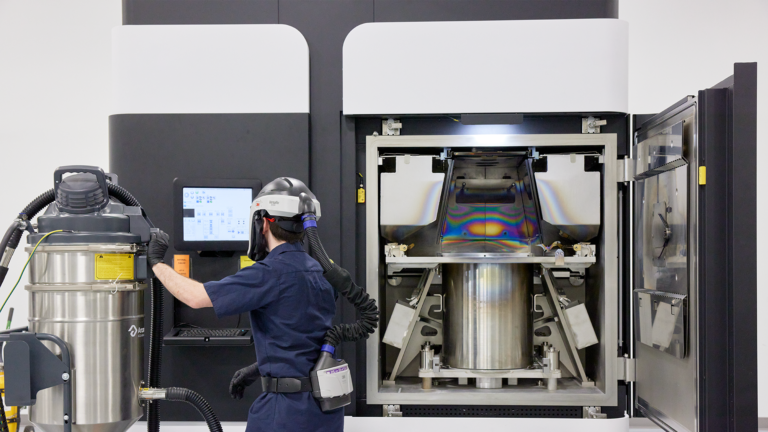
Metal additive manufacturing has transformed the way industries design and produce complex metal components. Aerospace, medical, automotive, defense, energy, and advanced engineering companies are using metal 3D printing to reduce material waste, manufacture complex geometries, improve product development cycles, and create lightweight high-performance parts.
Two of the most widely recognized metal powder-based additive manufacturing technologies are Laser Powder Bed Fusion (LPBF) and Electron Beam Melting (EBM).
Both technologies build metal parts layer by layer using digital CAD data, but they differ significantly in their energy source, operating environment, material compatibility, production characteristics, and ideal applications.
Choosing between laser-based metal 3D printing and EBM depends on several factors:
Required part performance
Material selection
Component size
Surface finish requirements
Production volume
Application industry
Post-processing requirements
Total manufacturing cost
This guide explains the differences between laser and EBM metal 3D printing technologies and helps manufacturers identify the right solution for their application.
Table of Contents
Understanding Laser Metal 3D Printing
Laser metal 3D printing, commonly known as Laser Powder Bed Fusion (LPBF), uses a high-powered laser beam to selectively melt metal powder layer by layer.
The process takes place inside a controlled chamber filled with inert gas, such as argon or nitrogen, to prevent oxidation during printing.
The basic process includes:
A thin layer of metal powder is spread across the build platform.
A laser selectively melts areas defined by the CAD model.
The build platform lowers, and another powder layer is applied.
The process repeats until the final component is produced.
Common laser-based technologies include:
Selective Laser Melting (SLM)
Direct Metal Laser Sintering (DMLS)
Laser Powder Bed Fusion (LPBF)
Advantages of Laser Metal 3D Printing
1. High Accuracy and Fine Detail
Laser systems provide excellent control over the melt pool, making them suitable for parts requiring:
Fine features
Thin walls
Complex geometries
Detailed structures
Tight dimensional requirements
This makes laser-based systems popular in applications where precision is critical.
2. Wide Material Selection
Laser powder bed fusion supports a broad range of metal materials, including:
Stainless steel
Titanium alloys
Aluminium alloys
Inconel
Nickel alloys
Cobalt chrome
Tool steels
This flexibility allows manufacturers to select materials based on strength, weight, corrosion resistance, temperature resistance, and application requirements.
3. Excellent Surface Quality
Laser systems generally provide better surface finish compared with many metal additive manufacturing processes.
They are suitable for components requiring:
Detailed surfaces
Complex features
Reduced machining requirements
Improved aesthetic quality
However, critical surfaces may still require machining or finishing.
4. Suitable for Complex Geometries
Laser metal 3D printing enables production of:
Internal channels
Lightweight lattice structures
Topology-optimized components
Consolidated assemblies
Complex engineering parts
This makes it highly valuable for aerospace and medical applications.
Electron Beam Melting (EBM) is a metal additive manufacturing process that uses an electron beam as the energy source instead of a laser.
The process takes place inside a vacuum environment.
The electron beam selectively melts metal powder according to the digital design, building the component layer by layer.
The basic EBM process includes:
Metal powder is spread over the build platform.
An electron beam selectively melts the powder.
The build platform lowers.
Additional powder layers are deposited.
The process repeats until the part is complete.
EBM is particularly known for processing reactive materials such as titanium alloys.
Advantages of EBM Metal 3D Printing
1. Excellent for Titanium and High-Performance Alloys
EBM is widely used for titanium-based applications because the vacuum environment reduces contamination risk.
Common materials include:
Titanium alloys
Cobalt chrome
Nickel-based alloys
Applications include:
Aerospace components
Medical implants
High-performance engineering parts
2. Reduced Thermal Stress
One major advantage of EBM is its elevated build temperature environment.
The heated powder bed helps reduce:
Residual stress
Distortion
Warping
This can reduce the need for extensive support structures compared with some laser processes.
3. Faster Build Rates for Certain Applications
EBM can provide higher deposition rates in specific applications due to the powerful electron beam and multiple melt pool control.
This can be beneficial for:
Larger components
Titanium parts
Production-oriented applications
4. Vacuum Processing Environment
The vacuum environment provides advantages for reactive materials.
Benefits include:
Reduced oxidation
Better material purity
Controlled processing conditions
Schedule A Call
+91 990-000-3300
Limitations of EBM Metal 3D Printing
Lower Surface Resolution
Compared with laser systems, EBM generally produces:
Rougher surfaces
Larger feature sizes
Less fine detail
Additional machining or finishing may be required.
Limited Material Range
EBM is commonly associated with titanium and specific high-performance alloys. Laser systems generally support a wider material selection.
Larger Minimum Feature Size
Applications requiring very small details or thin structures may be better suited for laser powder bed fusion.
Laser vs EBM Metal 3D Printing Comparison
Factor
Laser Metal 3D Printing
EBM Metal 3D Printing
Energy Source
Laser beam
Electron beam
Environment
Inert gas chamber
Vacuum chamber
Surface Finish
Generally smoother
Typically rougher
Accuracy
Higher detail capability
Good for larger features
Material Range
Very wide
More focused
Best Materials
Steel, titanium, aluminium, nickel alloys
Titanium, cobalt chrome, selected alloys
Thermal Stress
Higher
Lower due to heated build environment
Build Speed
Depends on system
Often faster for certain applications
Feature Size
Smaller details possible
Larger feature focus
Best Applications
Precision components
Large titanium and performance parts
Laser vs EBM: Which Technology Is Better for Aerospace?
Both technologies are used in aerospace, but the choice depends on the component.
Laser Powder Bed Fusion is suitable for:
Lightweight brackets
Complex structures
Heat exchangers
Small precision components
Topology-optimized parts
EBM is suitable for:
Titanium aerospace structures
Large components
High-performance parts
Components requiring reduced thermal stress
The decision depends on material, size, certification requirements, and production strategy.
Laser vs EBM: Which Technology Is Better for Medical Applications?
Medical applications often require:
Biocompatibility
Complex geometry
Porous structures
High accuracy
Laser systems are widely used for:
Dental components
Surgical instruments
Complex implants
EBM is popular for:
Titanium orthopedic implants
Bone-contact implants
Large medical components
The correct choice depends on implant design, material, surface requirements, and regulatory considerations.
Cost Comparison: Laser vs EBM Metal 3D Printing
The total cost depends on:
Machine investment
Material cost
Production volume
Build time
Post-processing
Maintenance
Inspection requirements
Laser Systems
Cost factors:
Laser power
Number of lasers
Powder consumption
Gas requirements
Support removal
EBM Systems
Cost factors:
Vacuum system
Electron beam technology
Powder handling
Material availability
Post-processing requirements
The lowest equipment price does not always provide the lowest production cost. Manufacturers should evaluate cost per part and total workflow requirements.
How to Choose Between Laser and EBM Metal 3D Printing
Manufacturers should consider:
Choose Laser Metal 3D Printing When:
High accuracy is required
Fine details are important
Wide material selection is needed
Surface finish is critical
Complex geometries are required
Choose EBM Metal 3D Printing When:
Titanium processing is important
Large components are required
Thermal stress reduction is needed
High-performance materials are required
Production involves aerospace or medical applications
Combining Metal Additive Manufacturing With Post-Processing
Regardless of technology, metal 3D printed parts often require finishing.
Common post-processing includes:
Heat treatment
Stress relief
CNC machining
Surface finishing
Shot blasting
Polishing
Inspection
Testing
A complete manufacturing strategy should include printing, finishing, and quality validation.
Conclusion
Laser and EBM metal 3D printing technologies both provide powerful solutions for industrial additive manufacturing, but they serve different production needs.
Laser metal 3D printing is ideal for manufacturers requiring high accuracy, detailed geometries, and a broad range of metal materials. EBM is particularly valuable for titanium components, aerospace applications, medical implants, and parts where thermal control is important.
The right choice depends on your application requirements, material selection, part size, accuracy needs, production volume, and post-processing workflow.
Lodestar 3D helps manufacturers evaluate metal additive manufacturing technologies, including laser powder bed fusion, EBM, WAAM, materials, and complete production workflows to achieve reliable Industry 4.0 manufacturing outcomes.
Laser metal 3D printing uses a laser beam inside an inert gas environment, while EBM uses an electron beam inside a vacuum chamber. Both melt metal powder layer by layer but have different strengths and applications.
Neither technology is universally better. EBM is often preferred for titanium and large high-performance parts, while laser systems are preferred for detailed components and wider material selection.
Both are used in aerospace. Laser systems are suitable for lightweight precision components, while EBM is often selected for titanium and larger aerospace parts.
Laser metal 3D printing generally provides finer details and smoother surfaces compared with EBM. However, final surface quality depends on material, parameters, and post-processing.
Yes. Both technologies can produce functional production parts when supported by proper process control, material selection, post-processing, and quality validation.