

How HIP Removes Porosity and Improves Metal Part Density
Internal porosity is one of the most important quality concerns in metal components. Small pores, voids and trapped gaps can form during casting, sintering, powder processing or metal additive manufacturing.
Although these defects may not be visible on the surface, they can reduce material consistency and affect the performance of the finished component.
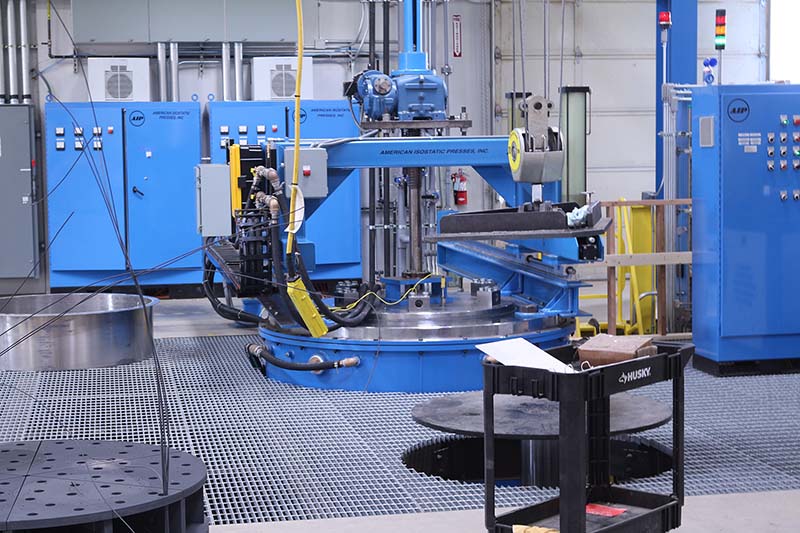
Hot Isostatic Pressing, commonly known as HIP, addresses this problem by applying high temperature and uniform gas pressure to a component inside a sealed pressure vessel. The combined action of heat, pressure and time can close suitable internal pores and bring the material closer to its theoretical density.
Table of Contents
What Is Porosity in Metal Parts?
Porosity refers to small internal spaces or voids within a metal component. These defects can vary in size, shape and distribution.
Porosity may develop because of:
- Trapped gas during solidification
- Shrinkage in metal castings
- Incomplete powder consolidation
- Insufficient fusion during metal 3D printing
- Irregularities during sintering
- Contamination or poor process control
A component may appear dimensionally correct while still containing internal porosity. These voids can create weak points where stress becomes concentrated during operation.
Residual porosity can limit mechanical performance and increase variation between otherwise similar components.
How Does HIP Remove Internal Porosity?
During the HIP process, a metal component is placed inside a pressure vessel containing an internal furnace. An inert gas, most commonly argon, surrounds the component.
The system then applies:
- Elevated temperature
- High isostatic gas pressure
- A controlled holding period
The word “isostatic” means that pressure acts equally from every direction. Instead of pressing the component from only one side, the gas applies uniform pressure across all exposed surfaces.
The elevated temperature makes the metal more responsive to deformation without melting it. At the same time, the external gas pressure pushes the internal surfaces of pores toward one another.
Porosity reduction occurs through a combination of:
Plastic Deformation
The material around a pore changes shape under pressure, reducing the volume of the void.
Creep
At elevated temperature, the metal gradually deforms under sustained pressure. This helps shrink pores during the holding stage.
Diffusion Bonding
Atoms move across the contacting internal surfaces, helping the closed pore surfaces bond together.
Through these mechanisms, suitable internal voids can shrink and close, creating a denser and more uniform material structure.
How Does HIP Improve Metal Density?
Metal density describes the amount of material contained within a particular volume. Internal pores reduce effective density because they occupy space without contributing solid metal.
When HIP closes these pores, the amount of empty internal space decreases. The component therefore moves closer to its maximum or theoretical density.
In suitable applications, HIP can produce near-fully dense or fully consolidated material. The exact result depends on the alloy, starting condition, pore type and selected process cycle.
Improved density can provide:
- More uniform material properties
- Better structural consistency
- Improved fatigue performance
- Increased ductility
- Better impact resistance
- Reduced variation between parts
- Improved reliability in demanding applications
HIP does not simply compress the outside of a part. Its primary effect is on suitable internal pores and voids throughout the material.

Which Metal Parts Can Benefit from HIP?
Metal Castings
Castings may contain shrinkage porosity or trapped gas voids formed during solidification. HIP can reduce suitable internal microporosity through plastic deformation and diffusion bonding.
Metal 3D-Printed Parts
Metal additive manufacturing can create complex components, but internal pores may remain depending on the material and printing parameters.
HIP is widely used as a post-processing step for suitable metal AM parts. Removing internal defects can improve density, fatigue behaviour, ductility and fracture toughness.
Sintered Components
Residual pores may remain after conventional sintering. HIP can further densify suitable sintered parts and improve consistency.
It is relevant to processes such as metal injection moulding, binder jetting and other powder-based manufacturing methods.
Powder Metallurgy Components
Metal powders can be enclosed in a sealed container and consolidated using heat and pressure. This can produce dense, near-net-shape components without melting the material.
Can HIP Remove Every Type of Porosity?
No. HIP is most effective when pores are internal and sealed from the external gas.
If a pore is connected to the component’s surface, pressurised gas may enter the defect and equalise the pressure. In that situation, the pore may not close effectively.
HIP may also be unable to correct:
- Large cracks
- Surface-breaking defects
- Contaminated pores
- Incorrect material chemistry
- Dimensional inaccuracies
- Defects that contain stable gases at high pressure
Parts should therefore be evaluated before processing. HIP is a powerful densification method, but it is not a replacement for correct casting, printing, sintering or quality-control procedures.
Selecting a HIP System for Metal Densification
The correct HIP system depends on:
- Component dimensions
- Required hot-zone diameter and length
- Metal or alloy type
- Required pressure
- Processing temperature
- Batch size
- Research or production volume
- Furnace configuration
- Future scale-up plans
Lodestar 3D supports the evaluation of AIP Hot Isostatic Press systems for laboratory research, process scale-up and production requirements.
For a broader explanation of the process, visit the Hot Isostatic Pressing Technology page. Customers can also review individual AIP laboratory and production HIP models based on their required capacity.
Conclusion
HIP removes suitable internal porosity by combining high temperature with uniform gas pressure. Temperature makes the metal more responsive to deformation, while pressure pushes pore surfaces together. Plastic deformation, creep and diffusion bonding then help shrink and close the internal voids.
The result can be a denser, more consistent and more reliable metal component.
HIP is particularly valuable for suitable castings, metal 3D-printed parts, sintered components and powder metallurgy products. However, the correct pressure, temperature, holding time and system configuration must be selected for each application.
Talk to a Lodestar 3D HIP expert to evaluate the appropriate AIP system for your material, component size and production requirements.
FAQ's
Can HIP make a metal component fully dense?
HIP can bring suitable components close to or up to their theoretical density. The result depends on the material, initial porosity and process conditions.
Does HIP change the external shape of a metal part?
A gas-tight solid component generally retains its overall shape because pressure acts uniformly. Small dimensional changes may occur, depending on the material and porosity level.
Is HIP suitable for metal 3D-printed components?
Yes. HIP is commonly used to reduce internal defects and improve the density of suitable metal additively manufactured parts.
Can HIP close surface-connected pores?
Not always. Gas can enter surface-connected pores, preventing the required pressure difference from forming across the defect.
How can Lodestar 3D help with HIP system selection?
Lodestar 3D can review the component size, material, required pressure, furnace temperature, hot-zone dimensions and production capacity to help identify a suitable AIP HIP system.