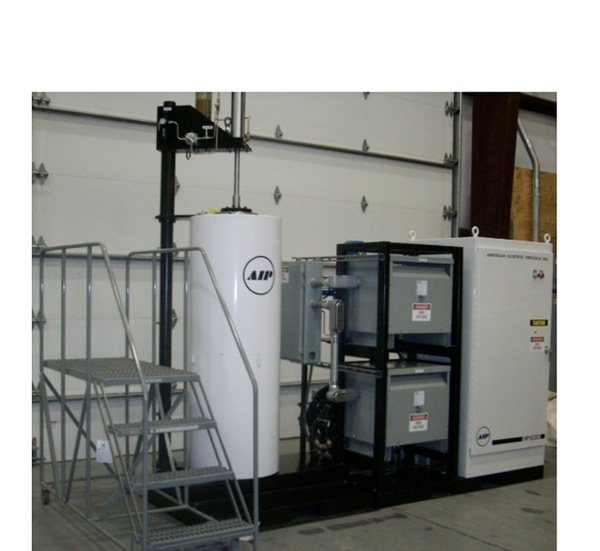
AIP6-30H Laboratory HIP: Features, Specifications and Research Applications
Source by lodestar3d.com
Hot Isostatic Pressing (HIP) is an advanced materials processing technology used to improve the density, strength, and quality of components. It combines high temperature and high gas pressure to consolidate materials and reduce internal porosity.
For universities, research laboratories, and materials development teams, a laboratory-scale HIP system provides a controlled environment for testing materials and developing new manufacturing processes.
The AIP6-30H Laboratory HIP from American Isostatic Presses is designed specifically for small-scale research applications. It can operate at pressures up to 30,000 psi (207 MPa) and supports different furnace configurations for high-temperature processing.
Table of Contents
What Is a Laboratory HIP?
A Hot Isostatic Press uses a pressurized gas, commonly argon or nitrogen, to apply pressure uniformly around a component while it is heated.
Unlike conventional pressing, HIP applies pressure from all directions. This helps close internal pores, improve material density, and produce more consistent material properties.
A laboratory HIP is particularly useful when researchers need to:
Test new materials
Study densification processes
Improve additive-manufactured parts
Consolidate metal or ceramic powders
Develop new HIP cycles
Perform small-scale material experiments
AIP6-30H Laboratory HIP Overview
The AIP6-30H is a compact research-scale HIP system designed for applications where controlled temperature and pressure are required.
According to the manufacturer, the system is intended for small research applications and can perform fast cycles from vacuum to full pressure, including SinterHIP processes.
Its compact working zone makes it suitable for research samples and small components while providing the pressure and furnace flexibility needed for advanced materials research.
The AIP6-30H can reach a maximum pressure of 30,000 psi (207 MPa). This high pressure helps researchers study densification and consolidation of different materials.
2. Multiple Furnace Options
One of the important features of the AIP6-30H is its interchangeable furnace design.
Available furnace options include:
Kanthal furnace
Molybdenum furnace
Carbon furnace
Platinum furnace
Tungsten furnace
The available temperature range depends on the selected furnace configuration. AIP lists furnace options ranging from approximately 1200°C to 2200°C.
3. Compact Working Zone
The listed working-zone size for the AIP6-30H is approximately 75 mm in diameter × 125 mm in length.
This makes the system suitable for laboratory samples, material research, and small components.
4. Controlled Processing Environment
The system can use different processing gases, including argon and nitrogen, depending on the application and configuration.
Controlled gas environments help researchers process materials while limiting unwanted reactions with the surrounding atmosphere.
5. SinterHIP Capability
The AIP6-30H can also support SinterHIP processing, which combines sintering and hot isostatic pressing in a controlled process.
This can be useful for powder-based materials and advanced ceramics where researchers want to improve densification and material properties.
6. Plug-In Furnace Design
The plug-in furnace configuration provides flexibility when researchers need to work with different materials and temperature requirements. AIP states that its laboratory HIP systems use plug-in furnace designs.
Specifications can vary depending on the furnace and system configuration, so the final configuration should be confirmed with the equipment supplier.
Research Applications of AIP6-30H
The AIP6-30H can be used in several areas of advanced materials research.
1. Additive Manufacturing Research
HIP is widely used to study and improve parts produced through metal additive manufacturing.
Researchers can use HIP to reduce internal porosity and improve the properties of 3D-printed components. For example, research on Ti-6Al-4V produced by Electron Beam Melting has used an AIP6-30H for HIP treatment under different temperature and pressure conditions.
This makes laboratory HIP useful for developing and optimizing post-processing methods for metal 3D printing.
2. Metal Powder Consolidation
HIP can consolidate metal powders into dense components.
Researchers can investigate different combinations of:
Powder composition
Temperature
Pressure
Holding time
Heating and cooling rates
These experiments can help develop new powder-based manufacturing processes.
3. Ceramic Research
The AIP6-30H can also be used for ceramic processing and densification.
Researchers have used AIP6-30H systems to process advanced ceramic materials at high temperatures and pressures.
HIP can help reduce porosity and improve the density and properties of ceramic materials.
4. Materials Development
Researchers developing new alloys, ceramics, composites, and other advanced materials can use HIP to study how materials behave under high temperature and pressure.
This allows researchers to test different processing parameters before moving toward larger-scale production.
5. Nuclear Materials Research
Laboratory HIP systems can also support nuclear materials research.
For example, the University of Sheffield has used an AIP6-30H for research related to the consolidation and immobilization of radioactive waste forms.
6. Near-Net-Shape Manufacturing Research
HIP can be used to produce near-net-shape components from powders or other feedstocks.
This can reduce the amount of additional machining required and makes HIP useful for research into advanced manufacturing methods.
Schedule A Call
+91 990-000-3300
Benefits of Using AIP6-30H for Research
The AIP6-30H offers several benefits for laboratories and research organizations:
Flexible: Different furnace configurations can support different materials and temperatures.
High pressure: Up to 207 MPa provides the pressure needed for many densification and consolidation studies.
Compact: Its laboratory-scale working zone is suitable for research samples and small components.
Process control: Researchers can study the effects of temperature, pressure, and processing time.
Versatile: It can be used for metals, ceramics, additive-manufactured materials, powders, and other advanced materials.
Suitable for process development: Researchers can develop and validate HIP cycles before scaling up to larger systems.
AIP6-30H for Additive Manufacturing
As metal additive manufacturing continues to grow, post-processing has become an important part of producing high-quality components.
Metal 3D-printed parts can contain internal pores or other imperfections depending on the printing process and parameters. HIP can help reduce internal porosity and improve material consistency.
This makes a laboratory HIP valuable for universities, R&D centers, and companies developing:
Metal 3D printing processes
New metal alloys
Aerospace components
Medical components
High-performance engineering parts
Powder-based manufacturing processes
Research facilities can use the AIP6-30H to test HIP parameters on small batches before applying the process to larger production systems.
For organizations that are still developing their process, a laboratory HIP can provide a practical way to understand the relationship between temperature, pressure, material structure, and final properties.
Why Choose a Laboratory HIP for Materials Research?
Moving directly to a large production HIP system may not be practical when a process is still under development.
A laboratory system allows researchers to work with smaller sample sizes and test different processing conditions. Once the process is validated, the results can support future scale-up.
The AIP6-30H is therefore positioned as a research-focused system rather than a high-volume production machine.
Conclusion
The AIP6-30H Laboratory HIP is designed for research and small-scale advanced materials processing. With pressure up to 207 MPa, a compact working zone, interchangeable furnace options, and support for HIP and SinterHIP processes, it provides flexibility for materials research.
From metal additive manufacturing and powder consolidation to ceramic processing and nuclear materials research, the system can help researchers investigate new materials and optimize processing conditions.
For laboratories planning to develop or scale advanced manufacturing processes, the AIP6-30H can serve as a useful bridge between material research and larger-scale industrial HIP processing.
FAQ's
1. What is the AIP6-30H Laboratory HIP?
The AIP6-30H is a research-scale Hot Isostatic Press designed for small-scale materials research and processing.
2. What is the maximum pressure of the AIP6-30H?
The AIP6-30H has a maximum pressure of 30,000 psi (207 MPa).
3. What materials can be processed using the AIP6-30H?
Depending on the furnace and process configuration, it can be used for research involving metals, ceramics, powders, composites, and additive-manufactured materials.
4. What is the working zone of the AIP6-30H?
The listed working zone is approximately 75 mm in diameter × 125 mm in length.
5. Can the AIP6-30H be used for metal 3D printing research?
Yes. AIP6-30H systems have been used in research involving additively manufactured metal parts, including studies on HIP treatment of Ti-6Al-4V components.
6. What is SinterHIP?
SinterHIP is a process that combines sintering with hot isostatic pressing to help densify powder-based materials under controlled temperature and pressure.
7. Why is HIP important for additive manufacturing?
HIP can help reduce internal porosity and improve the consistency and properties of metal additive-manufactured components.
8. Is the AIP6-30H suitable for production manufacturing?
The AIP6-30H is primarily designed for small research applications. Larger HIP systems are generally more suitable when higher production volumes or larger components are required.