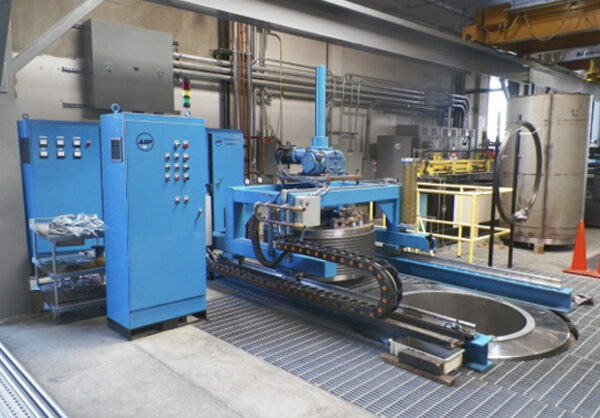
Hot Isostatic Press Machine Price in India: What Determines the Cost?
Source by lodestar3d.com
If you are researching the Hot Isostatic Press machine price in India, you may quickly notice that most industrial HIP manufacturers do not publish a standard price list.
That is because a Hot Isostatic Press is not normally an off-the-shelf machine with one fixed configuration. The final system is selected according to required pressure, operating temperature, hot-zone dimensions, furnace design, component size, production capacity, controls and installation requirements.
American Isostatic Presses (AIP), for example, provides HIP systems ranging from compact research equipment to large production machines and directs customers to request project-specific pricing rather than publishing standard retail prices.
For an Indian buyer, the correct question is therefore not simply “What does a HIP machine cost?” but “What HIP configuration does my process require?”
Table of Contents
Is There a Fixed Price for a Hot Isostatic Press in India?
No. There is generally no single fixed price for an industrial Hot Isostatic Press.
A laboratory system designed for small research samples can have substantially different equipment requirements from a large production HIP capable of processing large components or multiple parts per cycle.
A public Indian corporate filing provides a useful illustration of how significantly production-system costs can vary. In a December 2025 quotation, an AIP18-60-30H HIP system was listed at US$1.2 million, corresponding to approximately ₹108.59 million (₹10.86 crore) in the filing. An AIP22-84-30H threaded system was quoted at US$1.995 million, corresponding to approximately ₹180.52 million (₹18.05 crore).
These figures are specific historical project quotations, not general AIP list prices and not quotations for every HIP model. Actual pricing can vary significantly according to configuration, project scope, exchange rates, logistics and installation requirements.
What Factors Affect HIP Machine Price?
1. Hot-Zone Size
Hot-zone diameter and length are among the biggest factors affecting system size and cost.
A small research system only needs to accommodate laboratory samples. A production HIP may need enough space for large components or complete production batches.
Lodestar 3D’s current HIP range illustrates this progression. The AIP6-30H is positioned for compact laboratory work, while the AIP52-15H has an 1100 mm diameter × 2500 mm long hot zone for large production requirements.
As usable processing volume increases, the furnace, pressure vessel, gas-handling system and structural requirements generally become more substantial.
2. Required Pressure
HIP systems operate under extremely high gas pressure.
AIP states that its typical HIP systems operate within approximately 15,000 to 30,000 psi, although different configurations are available.
Higher pressure capability may require:
Different pressure-vessel construction
Larger or more capable gas compressors
Additional safety systems
Different seals and piping
More complex engineering and certification
The highest-pressure system is therefore not automatically the best choice.
The correct machine should provide the pressure required by the validated material process.
3. Furnace Temperature
Furnace temperature is another major configuration factor.
Different materials require different processing temperatures. Metal alloys, ceramics and specialised powder systems may therefore need different furnace technologies.
AIP systems can operate at temperatures reaching approximately 2,000°C in suitable configurations.
Higher-temperature furnace requirements can affect:
Heating-element materials
Thermal insulation
Furnace construction
Cooling requirements
Power consumption
Maintenance requirements
A buyer should therefore define the required operating temperature instead of automatically requesting the highest available furnace temperature.
4. Laboratory, Scale-Up or Production System
The intended development stage strongly affects equipment cost.
Laboratory HIP
Designed for:
Research
Material development
Small samples
Process optimisation
University and R&D laboratories
Scale-Up HIP
Designed for:
Larger samples
Pilot testing
Pre-production validation
Research-to-production transition
Production HIP
Designed for:
Larger components
Multiple-part batches
Repeated production cycles
Industrial throughput
Lodestar 3D currently presents AIP systems covering this progression, including the AIP6-30H, AIP10-30H, AIP18-30H, AIP24-30H and AIP52-15H.
Choosing the right stage can help avoid paying for production capacity that is not yet required.
The pressure vessel is one of the most important components of a HIP system.
Depending on the equipment size and application, different vessel arrangements may be required.
Pressure-vessel design affects:
Maximum pressure
Equipment dimensions
Loading arrangement
Installation method
Inspection requirements
System certification
Long-term servicing
This is one reason two HIP machines with similar hot-zone sizes may still have different prices.
6. Automation and Control System
Modern HIP equipment uses computer-based controls to manage the complete process cycle.
Depending on the project, controls may include:
Automatic pressure control
Furnace temperature control
Cycle recipes
Data logging
Alarm monitoring
Operator access levels
Historical cycle records
Process reporting
Remote diagnostics
Research facilities may prioritise flexible parameter control, while production installations may require more extensive process documentation and repeatability.
The equipment price is only one part of the total HIP investment.
Indian buyers should also consider project-related requirements such as:
International freight
Insurance
Customs and import costs
Site preparation
Foundations
Electrical infrastructure
Gas supply
Cooling systems
Material-handling equipment
Installation
Commissioning
Training
Larger production systems may also require considerable floor space or special installation planning.
Therefore, comparing machines only on their equipment price can provide an incomplete picture.
8. Custom Engineering
HIP systems may require customisation when standard equipment does not meet the application.
Custom requirements may involve:
Special hot-zone dimensions
Higher or lower pressure
Special furnace configurations
Loading systems
Gas environments
Cooling requirements
Special controls
Facility-specific installation needs
AIP provides project-specific system engineering rather than limiting customers to a single standard machine format.
Custom engineering can increase initial investment but may be necessary to achieve the required production process.
What Information Is Needed to Get an Accurate HIP Price?
Before requesting a quotation, prepare the following information:
Material or alloy
Component dimensions
Maximum batch dimensions
Required pressure
Required temperature
Furnace preference
Required hot-zone diameter
Required hot-zone length
Number of parts per batch
Expected cycle frequency
Research or production application
Installation location
Future capacity plans
A detailed requirement allows the equipment supplier to recommend the correct system instead of providing a broad budget estimate.
Schedule A Call
+91 990-000-3300
Buying a HIP System Through Lodestar 3D in India
Lodestar 3D supports Indian organisations evaluating AIP Hot Isostatic Press systems for laboratory research, sample scale-up and industrial production.
The evaluation process can help determine the correct combination of:
Hot-zone size → Pressure → Temperature → Furnace → Production capacity → Installation requirements
Lodestar 3D also positions its HIP offering around system evaluation, furnace selection, pressure and working-zone assessment, installation planning and training coordination in India.
This approach is particularly important for HIP equipment because the lowest-cost machine may not be the lowest-cost solution if it cannot accommodate future components or production requirements.
Conclusion
There is no universal Hot Isostatic Press machine price in India because HIP systems are configured around specific materials, component sizes and processing requirements.
Hot-zone dimensions, pressure, furnace temperature, production capacity, vessel design, controls, certification, installation and custom engineering all influence the final investment.
Publicly disclosed project quotations demonstrate that large production HIP installations can represent multi-crore capital investments, while compact research and scale-up systems have fundamentally different configurations and should be quoted separately.
For an accurate price, buyers should first define their technical requirements and then obtain a configuration-specific proposal.
Contact Lodestar 3D to discuss your component size, pressure, temperature and production requirements and request a project-specific AIP HIP system quotation.
FAQ's
What is the price of a Hot Isostatic Press machine in India?
There is no standard fixed price. HIP machine cost depends on hot-zone dimensions, pressure, furnace temperature, production capacity, controls, certification and installation requirements.
Why are HIP machine prices usually available only on request?
HIP systems are engineering-intensive capital equipment and are commonly configured around the buyer's material, component size and process requirements. AIP itself uses a project-specific “Design & Price” and quotation approach.
Is a laboratory HIP cheaper than a production HIP?
Generally, laboratory systems are smaller and require less processing capacity than large production systems. However, final price still depends on pressure, furnace configuration and options.
What should I provide when requesting a HIP quotation?
Provide your material, component dimensions, required pressure, temperature, desired hot-zone size, batch volume and expected production frequency.
Should I choose the lowest-priced HIP system?
Price should be considered together with process capability, hot-zone size, future capacity, installation requirements and lifecycle support. A lower-cost system that cannot support the required process or future scale-up may not provide the best long-term value.
How can Lodestar 3D help with HIP pricing in India?
Lodestar 3D can help define the required pressure, temperature, hot-zone size and system capacity before a project-specific AIP HIP quotation is prepared.