WaxJet 51C: Complete Buying Guide for Jewelry Manufacturers
Source: Lodestar3d.com
Jewelry manufacturers are under pressure to deliver detailed designs faster, reduce manual wax work, improve casting consistency, and handle more custom orders without slowing production. Traditional hand-carved wax patterns still have value, but they are difficult to scale when design complexity, repeatability, and turnaround time become important.
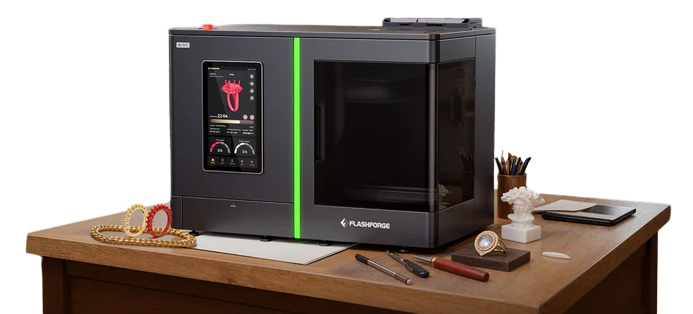
The WaxJet 51C is designed for jewelry manufacturers, casting houses, wax pattern producers, design studios, and small-to-medium workshops that need a compact wax 3D printing solution for investment casting workflows.
Unlike general resin 3D printers, the WaxJet 51C uses MultiJet Printing technology to produce true wax patterns. This makes it suitable for jewelry casting applications where burnout behavior, surface detail, fine features, and pattern consistency matter.
For Indian jewelry businesses, Lodestar 3D offers the WaxJet 51C as a compact production wax 3D printer for manufacturers looking to move from manual wax modeling or resin pattern printing toward a more casting-focused digital workflow.
Table of Contents
What Is the WaxJet 51C?
The WaxJet 51C, also listed as WJ51C, is a compact desktop wax 3D printer developed for jewelry pattern production.
It is built for manufacturers who need high-detail wax models for casting but may not have the space, budget, or production requirement for a large floor-standing wax printer.
The machine uses MultiJet Printing technology. In this process, wax material is jetted in controlled droplets to build jewelry patterns layer by layer. Support wax is also deposited where needed, helping support complex geometries during printing.
After printing, the support material is removed, and the wax model can be used in the jewelry casting workflow.
Who Should Consider Buying WaxJet 51C?
The WaxJet 51C is most suitable for jewelry businesses that need reliable wax pattern production without setting up a large industrial printing room.
It can be considered by:
Jewelry manufacturers
Gold jewelry workshops
K gold jewelry manufacturers
Silver and copper jewelry producers
Wax pattern service providers
Casting houses
CAD jewelry design studios
Custom jewelry brands
Retailers with in-house design and casting support
Small-batch production units
Jewelry training and design institutes
It is especially useful for businesses that frequently produce rings, pendants, earrings, bracelets, ornaments, custom designs, and detailed casting patterns.
One of the biggest advantages of WaxJet 51C is that it produces wax patterns, not resin substitutes.
For jewelry manufacturers, this matters because casting quality depends heavily on how the pattern behaves during burnout. True wax patterns can support cleaner casting workflows and reduce problems associated with some resin-based casting materials.
This makes WaxJet 51C relevant for manufacturers who want smoother transition from CAD design to castable wax model.
2. Compact desktop format
Many jewelry workshops operate in limited spaces. A large industrial printer may not be practical for smaller manufacturers or design studios.
The WaxJet 51C is designed as a compact desktop system, making it easier to place in a design room, workshop, or production office.
This allows businesses to introduce wax 3D printing without reorganizing the entire factory floor.
3. High-resolution jewelry detail
Jewelry designs often include thin prongs, filigree patterns, stone settings, textures, engravings, and small decorative elements.
The WaxJet 51C supports high-resolution printing with fine layer thickness, helping produce detailed patterns with smooth surfaces.
This is important for high-value jewelry where small surface defects can increase finishing time after casting.
4. Suitable for small-batch production
Not every jewelry manufacturer needs a large production printer. Many businesses need flexibility for custom orders, short runs, prototypes, and daily wax pattern production.
WaxJet 51C fits this requirement by supporting small-batch jewelry production without requiring a large production machine.
5. Lower dependency on manual wax carving
Manual wax modeling requires skill, time, and repeat effort. Digital wax printing allows manufacturers to create multiple patterns from CAD files with better repeatability.
This helps businesses reduce manual dependency and improve order consistency.
Before purchasing WaxJet 51C, jewelry manufacturers should evaluate practical production requirements, not only machine specifications.
Build volume
Build volume determines how many jewelry patterns can be printed in one job and what size of model can be produced.
WaxJet 51C offers a compact build size suitable for jewelry patterns, small components, and custom designs. It is not intended for very large batch production like bigger floor-standing wax systems.
For small and medium jewelry businesses, the build volume may be sufficient for daily pattern needs. For high-volume factories, a larger WaxJet model may be more appropriate.
Print quality
For jewelry, surface finish and edge detail are critical.
Evaluate sample prints before buying. Check:
Prong detail
Stone setting accuracy
Surface smoothness
Fine text or engraving
Thin wall stability
Ring shank consistency
Support removal quality
Casting results after burnout
The best way to evaluate any wax 3D printer is to test it using your own CAD designs.
Material workflow
WaxJet 51C uses part wax and support wax. Jewelry manufacturers should understand material consumption, loading method, storage requirements, support removal process, and recurring material cost.
Material utilization is important because wax consumption affects cost per pattern.
Software compatibility
The printer supports standard jewelry CAD workflows through accepted file formats. Manufacturers should confirm whether their existing CAD software can export suitable files for the WaxJetPrint workflow.
Common jewelry CAD software users should check file preparation, orientation, nesting, and support workflow before purchase.
Operating environment
Wax 3D printers require stable operating conditions. Temperature and humidity should be controlled to maintain reliable print quality.
Before installation, confirm:
Available space
Power supply
Ventilation
Operator access
Material storage
Cleaning and support-removal area
CAD-to-print workflow
Post-print handling process
WaxJet 51C vs Resin Printers for Jewelry
Many jewelry manufacturers compare wax printers with resin printers because resin printers are often cheaper.
However, the two technologies serve different purposes.
Resin printers may be suitable when:
The budget is limited
The business is focused on design validation
Casting requirements are basic
Surface finishing is manageable
Resin burnout is acceptable for the workflow
WaxJet 51C may be better when:
True wax patterns are preferred
Casting reliability is important
Fine jewelry detail is required
Support removal must protect delicate features
The workshop wants a more production-focused casting workflow
The business wants to reduce resin burnout challenges
For serious jewelry casting, a wax printer can offer a more direct route from CAD model to casting pattern.
Schedule A Call
+91 990-000-3300
WaxJet 51C vs Larger WaxJet Printers
WaxJet 51C is designed for compact production and small-batch jewelry manufacturing.
Larger WaxJet systems may offer greater build capacity and higher production output, but they also require more floor space, higher investment, and more production planning.
Choose WaxJet 51C if you need:
Compact installation
Desktop wax printing
Custom jewelry production
Small-batch manufacturing
Design studio integration
Lower entry point into wax 3D printing
Consider a larger WaxJet system if you need:
Higher batch production
Larger daily wax output
Multiple operators
Factory-scale workflow
Higher production throughput
Cost and ROI Considerations
The price of WaxJet 51C depends on supplier quotation, taxes, import conditions, installation support, materials, service package, and accessories.
Instead of judging only machine price, jewelry manufacturers should calculate ROI based on:
Number of wax patterns printed per month
Current manual wax labor cost
Outsourced wax printing cost
Casting defect reduction
Time saved in design-to-pattern workflow
Customer order turnaround time
Material consumption per pattern
Repeat order volume
Reduction in rejected patterns
Ability to accept more custom jobs
A wax 3D printer can justify itself when it helps the business produce more patterns faster, reduce manual bottlenecks, improve consistency, and support more design complexity.
Buying Checklist for Jewelry Manufacturers
Before finalizing the WaxJet 51C, confirm:
Your monthly wax pattern requirement
Typical jewelry model size
Required surface finish
Casting workflow compatibility
Material cost and availability
Support removal process
CAD file workflow
Operator training requirement
Installation space
Service and support availability
Warranty and maintenance terms
Sample print quality
ROI based on real production data
Conclusion
The WaxJet 51C is a strong option for jewelry manufacturers that need compact, high-precision wax 3D printing for casting patterns, prototypes, and small-batch production.
It is especially useful for workshops that want to reduce manual wax carving, improve CAD-to-casting workflow, produce detailed jewelry patterns, and handle custom orders more efficiently.
The best buying decision should be based on real production needs, sample print evaluation, material workflow, casting quality, operating cost, and long-term service support.
Lodestar 3D helps jewelry manufacturers evaluate WaxJet 51C for their workflow, production volume, design requirements, and casting process.
The WaxJet 51C is used to produce high-precision wax patterns for jewelry casting, rapid prototyping, custom jewelry design, and small-batch production.
Yes. WaxJet 51C is designed as a compact desktop wax 3D printer, making it suitable for small and medium jewelry workshops, design studios, and casting service providers.
For casting-focused jewelry production, WaxJet 51C can be better because it produces true wax patterns. Resin printers may be lower-cost but may require more careful burnout validation.
Check your monthly production requirement, model size, material cost, casting workflow, sample print quality, support removal process, installation needs, and supplier support.