How to Choose the Right 3D Printer for Dental Applications
Digital dentistry has transformed how dental laboratories, clinics, and medical device manufacturers design and produce dental solutions. Traditional dental workflows that depended heavily on manual modeling, impressions, and fabrication processes are increasingly being replaced by digital scanning, CAD design, and additive manufacturing.
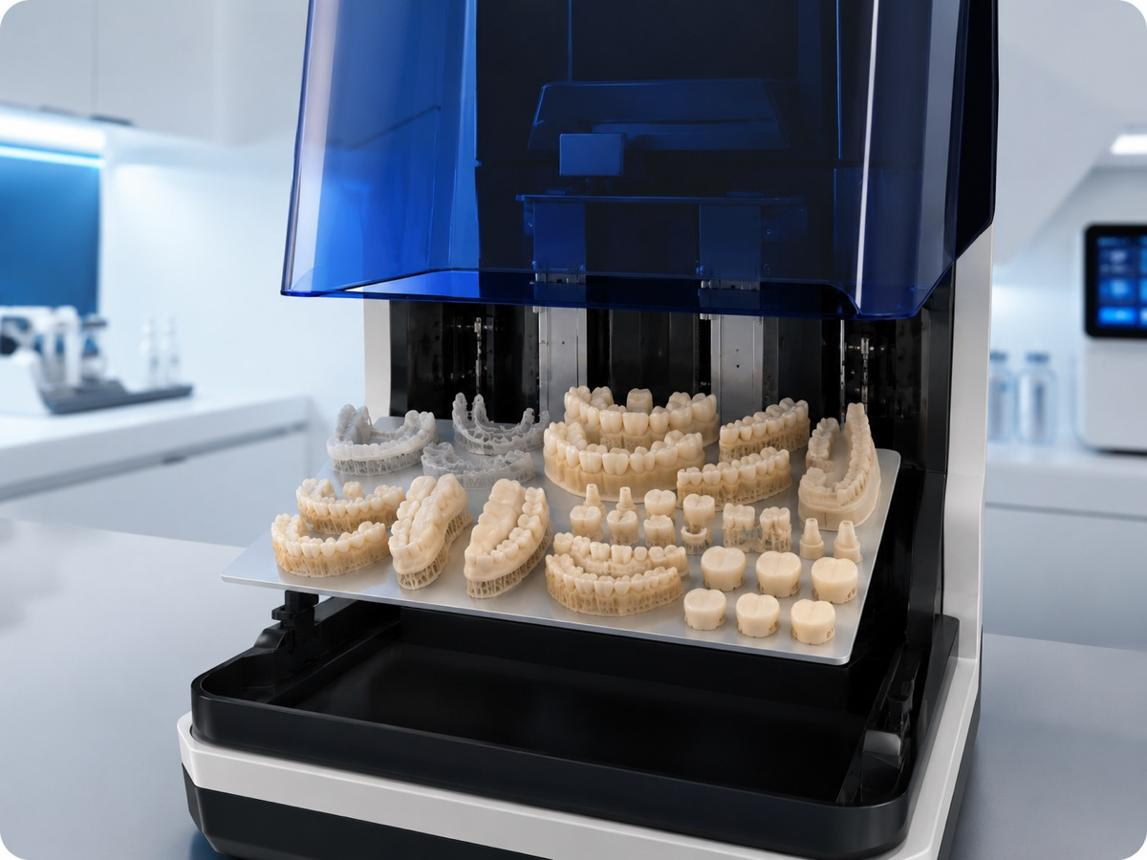
A 3D printer for dental applications allows professionals to produce accurate dental models, surgical guides, orthodontic devices, prosthetic components, and other dental solutions directly from digital designs.
However, choosing the right dental 3D printer requires more than comparing print resolution or machine specifications. Dental applications demand high accuracy, material compatibility, repeatability, workflow integration, and validated performance.
The right system depends on:
- Type of dental application
- Required accuracy
- Material requirements
- Production volume
- Workflow compatibility
- Regulatory requirements
- Total cost of ownership
This guide explains the key factors dental laboratories and professionals should consider when selecting a dental 3D printing solution.
Table of Contents
Understanding Dental 3D Printing Technology
Dental 3D printing is an additive manufacturing process where digital dental designs are converted into physical parts layer by layer.
A typical digital dentistry workflow includes:
- Intraoral scanning or dental scanning
- Digital CAD design
- File preparation
- 3D printing
- Washing and post-processing
- Curing
- Finishing and quality inspection
Most dental 3D printers use resin-based technologies because they provide the accuracy and surface quality required for dental applications.
Common dental printing technologies include:
- SLA (Stereolithography)
- DLP (Digital Light Processing)
- LCD/MSLA resin printing
Each technology has different advantages depending on the application.
1. Define Your Dental Application First
The first step in selecting a dental 3D printer is understanding what you plan to produce.
Different applications require different materials, accuracy levels, and workflows.
Dental Models
Dental models are among the most common applications.
Used for:
- Treatment planning
- Orthodontic analysis
- Crown and bridge design
- Patient demonstrations
Requirements:
- High accuracy
- Fine details
- Smooth surfaces
- Fast production
Surgical Guides
Surgical guides require high precision because they assist clinicians during implant procedures.
Important requirements include:
- Dimensional accuracy
- Biocompatible materials
- Reliable repeatability
- Validated workflow
Orthodontic Applications
Dental 3D printing is widely used for:
- Clear aligner models
- Orthodontic study models
- Retainers
- Treatment planning
These applications require:
- High production efficiency
- Consistent accuracy
- Durable materials
Dentures and Prosthetic Applications
Dental printers can produce:
- Denture bases
- Try-in models
- Prosthetic components
These applications require suitable dental-grade materials and validated processing methods.
2. Choose the Right Dental 3D Printing Technology
SLA Dental 3D Printers
SLA uses a laser to cure liquid resin layer by layer.
Advantages:
- Excellent accuracy
- Smooth surface finish
- Fine feature reproduction
- Suitable for detailed dental models
Applications:
- Dental models
- Surgical guides
- Precision components
SLA is preferred when surface quality and detail are critical.
DLP Dental 3D Printers
DLP uses a digital light projector to cure an entire layer at once.
Advantages:
- Faster printing speed
- High accuracy
- Efficient batch production
Applications:
- Orthodontic models
- Dental appliances
- Laboratory production workflows
DLP technology can be beneficial for dental labs producing multiple parts per build.
LCD/MSLA Dental Printers
LCD-based resin printers use an LED light source and LCD masking system.
Advantages:
- Lower equipment cost
- Good resolution
- Suitable for various dental applications
However, industrial dental workflows should evaluate:
- Accuracy
- Material validation
- Long-term reliability
- Service support
3. Evaluate Print Accuracy and Resolution
Accuracy is one of the most important factors when selecting a dental 3D printer.
Dental applications require precise reproduction of:
- Tooth geometry
- Gum structures
- Implant positioning
- Occlusion details
- Anatomical features
When evaluating accuracy, consider:
- XY resolution
- Layer thickness
- Dimensional accuracy
- Repeatability
- Calibration stability
A printer with high resolution does not automatically guarantee accurate dental parts. The complete workflow, including resin, software, calibration, and post-processing, affects final results.
4. Consider Dental Resin Compatibility
Material selection is critical for dental applications.
Common dental resin categories include:
Model Resin
Used for:
- Dental study models
- Orthodontic planning models
- Patient demonstrations
Surgical Guide Resin
Used for:
- Implant surgical guides
- Clinical applications
Requires:
- Biocompatibility validation
- Proper curing workflow
Denture Resin
Used for:
- Denture bases
- Prosthetic applications
Castable Resin
Used for:
- Dental casting workflows
- Precision patterns
Before selecting a printer, verify:
- Supported dental materials
- Material certifications
- Resin availability
- Post-curing requirements
5. Check Build Volume and Production Capacity
Build volume affects how many dental parts can be produced in one printing cycle.
Dental laboratories should consider:
- Number of models per build
- Daily production requirements
- Part size
- Batch efficiency
For example:
A small clinic may need a compact system for occasional models.
A large dental laboratory may require a higher-throughput system capable of producing multiple models, guides, and appliances daily.
6. Evaluate Printing Speed and Workflow Efficiency
Dental production requires consistent turnaround times.
Printing speed depends on:
- Technology type
- Layer thickness
- Part orientation
- Number of parts
- Resin properties
However, total workflow time includes:
- Design preparation
- Printing
- Washing
- Drying
- UV curing
- Finishing
A faster printer is not always better if post-processing becomes a bottleneck.
7. Consider Software Compatibility
Dental 3D printing depends heavily on digital workflow integration.
The system should support:
- Dental CAD software
- STL files
- Digital scanning workflows
- Automated support generation
- Build preparation software
A smooth software workflow helps reduce errors and improves productivity.
8. Understand Post-Processing Requirements
Dental resin parts require proper post-processing.
Typical steps include:
Washing
Removes uncured resin from the printed part.
Support Removal
Removes temporary support structures.
UV Curing
Improves final material properties.
Finishing
May include:
- Polishing
- Surface cleaning
- Inspection
For clinical applications, following validated post-processing procedures is essential.
9. Consider Compliance and Material Validation
Dental applications may involve direct or indirect patient use.
Before selecting a printer, evaluate:
- Material certification
- Biocompatibility requirements
- Manufacturer documentation
- Regulatory considerations
- Quality control processes
The printer, resin, and workflow should work together as a validated system.
10. Evaluate Total Cost of Ownership
The cost of a dental 3D printing system includes more than the printer purchase price.
Consider:
- Printer investment
- Resin cost
- Build platform maintenance
- Resin tank replacement
- Washing equipment
- Curing equipment
- Software costs
- Service support
- Operator training
A complete cost analysis helps determine long-term value.
Dental 3D Printer Applications
Dental Laboratories
Applications:
- Dental models
- Surgical guides
- Orthodontic products
- Prosthetic workflows
Benefits:
- Faster production
- Reduced manual work
- Improved repeatability
Dental Clinics
Applications:
- Patient models
- Treatment planning
- Surgical preparation
Benefits:
- Better patient communication
- Faster workflow
Dental Research and Education
Applications:
- Anatomical models
- Training models
- Experimental designs
Benefits:
- Digital learning
- Custom educational tools
Dental 3D Printer Selection Checklist
Before investing, evaluate:
✓ Application requirements
✓ Required accuracy
✓ Supported dental materials
✓ Production volume
✓ Software compatibility
✓ Post-processing workflow
✓ Certification requirements
✓ Service support
✓ Operating costs
✓ Future expansion needs
Conclusion
Choosing the right 3D printer for dental applications requires careful evaluation of accuracy, materials, workflow, production requirements, and application goals.
SLA, DLP, and other resin-based technologies provide powerful solutions for modern digital dentistry, enabling faster production of accurate dental models, surgical guides, orthodontic components, and customized solutions.
The right dental 3D printing system can help laboratories and clinics improve efficiency, reduce manual processes, and integrate advanced digital manufacturing into their workflows.
Lodestar 3D helps dental professionals and manufacturers select suitable additive manufacturing solutions based on application requirements, materials, workflow, and production objectives.
FAQ's
The best dental 3D printer depends on the application. SLA and DLP systems are commonly selected because they provide high accuracy, surface quality, and compatibility with dental resins.
Dental 3D printers can produce models, surgical guides, orthodontic models, denture components, casting patterns, and other dental workflow products.
Yes. Resin-based 3D printing technologies such as SLA and DLP are widely used in dentistry because they provide the accuracy and detail required for dental applications.
Accuracy depends on the printer technology, resin, calibration, software, and post-processing workflow. Industrial dental printers are designed to provide the precision required for dental manufacturing.
Dental labs should consider application needs, material compatibility, production capacity, accuracy, workflow integration, support, and total operating costs.