

The Role of Industrial Robots in Wire Arc Additive Manufacturing
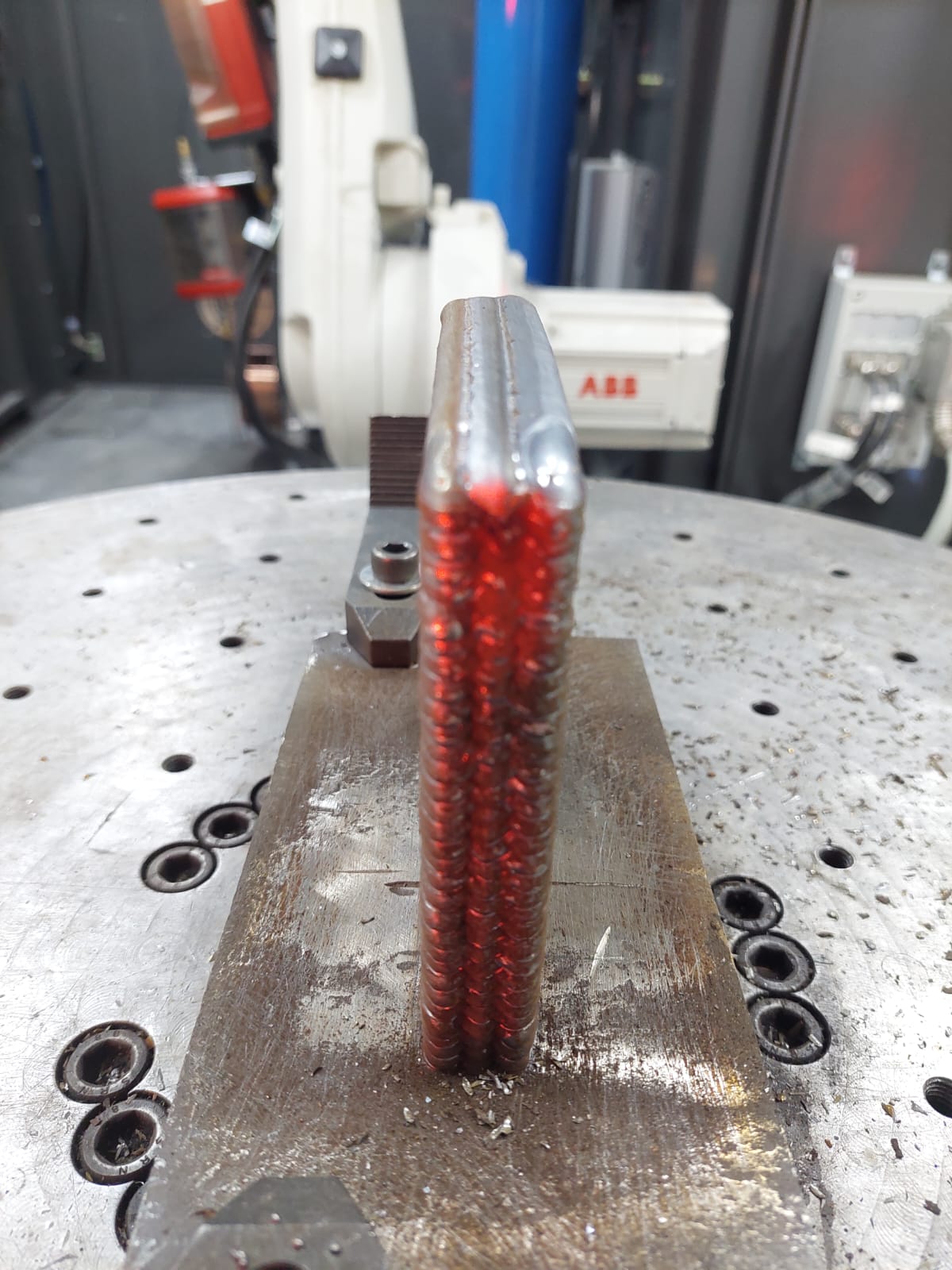
Wire Arc Additive Manufacturing depends on more than melting metal wire and depositing it in layers. The heat source creates the molten material, but an industrial robot determines where that material is placed, how the torch is oriented, how fast it moves, and how consistently the deposition path is repeated.
This makes industrial robots in Wire Arc Additive Manufacturing central to process accuracy, build flexibility, production scale, and part quality.
WAAM combines a continuously fed metallic wire with an arc-based heat source to manufacture near-net-shape components. In an industrial system, a robotic arm moves the deposition torch along a digitally programmed path. Positioners, sliders, gantries, sensors, and control software may work synchronously with the robot to build larger and more geometrically complex parts.
MetalWorm offers Compact Systems, Special Systems, and Lab Systems for different production, application, and research requirements. Through Lodestar 3D, Indian manufacturers can evaluate these robotic WAAM solutions for large-part production, tooling, repair, research, and process development.
Table of Contents
Why Are Industrial Robots Important in WAAM?
A conventional welding robot is commonly programmed to join existing components. In WAAM, similar robotic technology is used to create a new component by adding material.
The robot must maintain controlled motion throughout hundreds or thousands of deposition passes. Small variations in torch position, travel speed, or orientation can affect:
- Bead width and height
- Layer consistency
- Heat input
- Melt-pool behaviour
- Surface condition
- Dimensional accuracy
- Fusion between layers
- Final component geometry
The industrial robot therefore acts as the motion platform that converts a digital toolpath into a physical metal structure.
Its role extends beyond moving from one coordinate to another. The robot must operate as part of an integrated manufacturing system in which motion, wire feeding, heat input, workpiece positioning, cooling, monitoring, and safety are coordinated.
Precise Control of the Deposition Path
A conventional welding robot is commonly programmed to join existing components. In WAAM, similar robotic technology is used to create a new component by adding material.
The robot must maintain controlled motion throughout hundreds or thousands of deposition passes. Small variations in torch position, travel speed, or orientation can affect:
- Bead width and height
- Layer consistency
- Heat input
- Melt-pool behaviour
- Surface condition
- Dimensional accuracy
- Fusion between layers
- Final component geometry
The industrial robot therefore acts as the motion platform that converts a digital toolpath into a physical metal structure.
Its role extends beyond moving from one coordinate to another. The robot must operate as part of an integrated manufacturing system in which motion, wire feeding, heat input, workpiece positioning, cooling, monitoring, and safety are coordinated.

Precise Control of the Deposition Path
Every WAAM component begins with a digital model and a planned deposition strategy.
The geometry is divided into layers and converted into paths that the robot can follow. These paths define where the torch moves, when deposition begins, when it stops, and how each bead overlaps the previous bead.
The robot controls important motion variables such as:
- Torch trajectory
- Travel speed
- Torch angle
- Deposition direction
- Start and stop points
- Layer sequence
- Distance between the torch and workpiece
- Movement between deposited sections
Consistent path control is essential because each deposited layer becomes the foundation for the next one.
An error in an early layer may continue through the remaining build. Robot repeatability helps reduce this risk by allowing the same programmed movement to be performed consistently across the component.
Six-Axis Movement and Torch Orientation
Industrial WAAM systems commonly use six-axis robotic arms. These axes allow the robot to move the deposition torch through three-dimensional space and change its orientation.
This freedom of movement helps the system maintain a suitable torch angle while following:
- Curved surfaces
- Circular structures
- Inclined walls
- Variable cross-sections
- Reinforced geometries
- Complex external profiles
- Existing components during repair
A fixed vertical deposition system may be adequate for simple walls or cylindrical structures. More complex industrial parts require the torch to approach the workpiece from different directions.
Six-axis robots allow engineers to plan deposition according to part geometry rather than restricting every build to a single vertical direction.
Synchronization with Robotic Positioners
Robot movement alone may not provide sufficient access to every part of a large or complex component.
For this reason, WAAM systems frequently combine a six-axis robot with one or more external positioner axes. The positioner holds the workpiece and rotates, tilts, or reorients it while the robot controls the torch.
This coordinated movement can help:
- Maintain a favourable deposition position
- Improve access to difficult surfaces
- Reduce excessive robot-axis movement
- Control the influence of gravity on the melt pool
- Produce curved or rotational geometries
- Support deposition around cylindrical parts
- Improve reach across larger workpieces
MetalWorm Special Systems use different positioning concepts, including Skyhook, Drop Center, rotary, TH, and other multi-axis positioners.
The positioner is not merely a rotating table. It is an active part of the toolpath. Its movement must be synchronized with the robotic arm so that the torch and workpiece follow the intended relative path.
Expanding the Working Envelope with Sliders and Gantries
The natural reach of an industrial robot is limited by the length and arrangement of its arm.
Large-scale WAAM systems overcome this limitation by mounting robots on linear sliders, vertical axes, or gantries. These peripherals move the complete robot along a larger structure.
This allows robotic WAAM to address components that would otherwise extend beyond the robot’s normal reach.
MetalWorm Special Systems demonstrate several approaches:
- A robot combined with a vertical Z-axis and rotary positioner
- A robot mounted on a slider beside a Skyhook positioner
- Dual robots operating with sliders, a positioner, and a production table
- Multi-station systems using a gantry and different positioners
Such configurations enable the robot to move between larger working zones or manufacturing stations.
The result is a scalable architecture. Rather than relying on one fixed robot envelope, the system can be engineered around the size, weight, shape, and handling requirements of the target component.
Supporting Large and Heavy Metal Components
One of WAAM’s main industrial advantages is its suitability for comparatively large metal parts.
Large parts create challenges beyond deposition. The workpiece may need to be rotated, tilted, supported, or transferred while remaining stable and accurately positioned.
Industrial robots work with heavy-duty positioners and fixtures to maintain the correct relationship between the torch and the part.
MetalWorm Special Systems include configurations for workpieces ranging from substantial single-positioner components to multi-station systems handling much heavier loads. These systems show why the robot must be selected as part of a broader mechanical architecture rather than as an isolated machine.
Important selection factors include:
- Robot reach
- Robot payload
- Positioner capacity
- Component centre of gravity
- Fixture weight
- Torch and cable package
- Collision risk
- Required production envelope
- Number of manufacturing stations
Repeatability and Process Consistency
Repeatability is one of the most important contributions of industrial robotics to WAAM.
Manual welding depends heavily on operator movement and technique. A robot can repeat the same path, speed, torch angle, and sequence under programmed conditions.
This supports greater consistency across:
- Individual beads
- Consecutive layers
- Repeated components
- Repair operations
- Production batches
- Process-development experiments
Repeatability does not guarantee part quality by itself. Material behaviour, heat accumulation, wire consistency, shielding gas, and parameter control remain critical.
However, robotic repeatability creates a stable platform on which engineers can develop and validate those parameters.
When a process deviation occurs, teams can investigate material, thermal, electrical, environmental, or programming conditions without the same level of variability associated with manual torch movement.
Connecting Robotic Motion with Process Monitoring
Advanced WAAM systems do not operate only from a pre-programmed robot path. Sensors can monitor the process while software compares actual conditions with expected values.
MetalWorm systems can incorporate data from technologies such as:
- Pyrometers
- Laser distance sensors
- Welding-current and voltage sensors
- Gas-flow sensors
- Thermal welding cameras
- 3D cameras
- Profilometers
- Interferometric sensors
- Temperature and humidity sensors
- Microphones
Sensor readings can be linked with robot coordinates and timestamps. This enables engineers to determine where a particular temperature change, voltage fluctuation, geometry deviation, or process alarm occurred within the build.
The robot then becomes part of a traceable digital manufacturing environment rather than simply an automated motion device.
Closed-Loop Adjustment and Geometry Control
In a basic WAAM process, the robot follows a predetermined path from beginning to end.
Advanced systems can use monitoring data to adjust the process during production.
For example, control software may:
- Detect the distance between the torch and the deposited layer
- Modify robot height to maintain the required stand-off
- Measure a completed layer using a 3D sensor
- Correct the toolpath for the next layer
- Adjust travel speed based on temperature
- Coordinate wire-feed speed with heat-input requirements
- Pause deposition until a defined interpass temperature is reached
This closed-loop approach is important because WAAM parts change thermally and geometrically as they grow.
A path calculated from the original CAD model may no longer be ideal if the actual deposited height differs from the predicted value. Sensor-informed robot correction helps compensate for these changes.
Improving Productivity Through Multi-Robot and Multi-Station Systems
Industrial robots also allow WAAM capacity to scale beyond a single torch and workpiece.
Multi-station systems can enable robots to work across different positioners or production areas. Depending on the system design, one station may be prepared while another is in production.
Dual-robot systems can extend working coverage or support more complex manufacturing strategies. However, they require careful coordination to prevent collisions and maintain safe operating zones.
Potential productivity benefits include:
- Higher equipment utilization
- Reduced loading and unloading delays
- Parallel process preparation
- Larger working envelopes
- Better production sequencing
- Flexibility across different component types
The MetalWorm Multi Station Robotic WAAM System illustrates this scale-up approach by combining robots, a gantry, and multiple positioner types within one manufacturing environment.
Enabling Safer Automated Metal Deposition
WAAM involves high temperatures, electrical energy, arc radiation, moving machinery, shielding gases, hot components, and welding fumes.
Industrial robots allow deposition to take place inside a controlled cell while operators remain outside the active production area.
A robotic WAAM system can integrate:
- Safety fencing and interlocks
- Controlled access doors
- Emergency-stop systems
- Fume extraction
- In-cell lighting
- CCTV monitoring
- Torch-cleaning equipment
- Environmental sensors
- Audio and visual alarms
Automation reduces the need for an operator to remain close to the arc during extended deposition cycles.
Safety still depends on correct cell design, risk assessment, operator training, maintenance, and compliance with relevant industrial standards.
Industrial Robot Applications in WAAM
Robotic motion expands the range of parts and processes that WAAM can support.
Aerospace and defense
Multi-axis robots can produce structural preforms, frames, brackets, tooling, and selected replacement components. Robot and positioner coordination is useful for curved and rotational geometries.
Automotive manufacturing
Robotic WAAM can support forming tools, welding fixtures, prototype metal parts, motorsport components, and repair of large tools.
Industrial engineering
Large housings, custom machinery components, structural supports, flanges, and replacement parts can be manufactured near net shape before machining.
Foundry and casting
Robots can build molds, dies, tooling structures, and repair deposits on worn production equipment.
Energy and marine
Large flanges, pressure-related structures, marine components, and repair applications may benefit from flexible robotic deposition.
Research and education
MetalWorm’s Lab System provides a flexible robotic WAAM environment for investigating materials, deposition parameters, sensing, control, and process behaviour.
Choosing an Industrial Robot for WAAM
The largest robot is not automatically the best choice.
Robot selection should consider:
- Required working envelope
- Torch and wire-feeder weight
- Cable routing
- Positional repeatability
- Required travel speed
- Positioner coordination
- Environmental protection
- Maintenance access
- Future expansion
- Software compatibility
- Intended materials and processes
The broader system must also account for fixtures, positioner payload, component geometry, sliders, gantries, monitoring equipment, and safety provisions.
MetalWorm systems can be integrated with ABB, KUKA, and FANUC robots. The final brand and model can vary according to the application, industry, and required system architecture.
Conclusion: Industrial Robots as the Motion Platform for WAAM
Industrial robots transform Wire Arc Additive Manufacturing from an arc-deposition process into a programmable digital manufacturing system.
They provide the repeatable motion needed to control the torch path, deposition speed, orientation, and layer sequence. When synchronized with positioners, sliders, and gantries, robots can manufacture larger and more complex components. When connected to sensors and control software, they support traceability, geometry correction, anomaly detection, and closed-loop process adjustment.
The robot alone does not determine WAAM quality. Successful production also requires suitable wire, stable heat input, thermal management, tooling, process software, monitoring, machining, inspection, and application-specific qualification.
MetalWorm addresses these requirements through Compact Systems, Special Systems, and Lab Systems developed for different manufacturing scales and technical objectives.
Lodestar 3D supports manufacturers, R&D teams, and educational institutions across India in evaluating robotic WAAM solutions. Its technical team can help assess component size, geometry, payload, material, production workflow, sensing requirements, and post-processing needs before recommending an appropriate system.
FAQ's
Six-axis robots provide the movement and orientation flexibility needed to guide the deposition torch around curved, inclined, and complex metal geometries.
A positioner rotates or tilts the workpiece while the robot moves the torch. This improves access and helps maintain a suitable deposition orientation.
Yes. Robots can be combined with sliders, vertical axes, gantries, and heavy-duty positioners to expand the manufacturing envelope beyond the robot’s standard reach.
Advanced systems can use distance, geometry, temperature, and melt-pool data to modify robot height, travel speed, or the path of subsequent layers.
Yes. Robotic systems allow researchers to test repeatable toolpaths, materials, process parameters, sensors, thermal-control strategies, and closed-loop control methods.