

What Application and Industries We Can Reach?
Large metal components create manufacturing challenges that cannot always be solved efficiently through conventional production methods. Machining from solid material can generate significant waste. Casting and forging may require expensive tooling and long lead times. Repairing a high-value component can also become difficult when original drawings, tooling, or replacement parts are unavailable.
These challenges create important opportunities for WAAM Special System applications
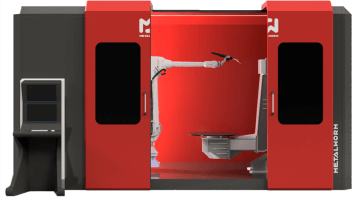
Wire Arc Additive Manufacturing, or WAAM, builds metal components by depositing continuously fed wire layer by layer using a controlled heat source. MetalWorm Special Systems extend this process into large-scale robotic manufacturing environments designed for substantial, heavy, or geometrically complex parts.
The systems can combine industrial robots, positioners, sliders, gantries, production tables, monitoring technologies, and process-control software. This allows each manufacturing environment to be configured according to the size, shape, weight, material, and production requirements of the intended component.
For Indian manufacturers, Lodestar 3D provides access to MetalWorm WAAM solutions for new-part production, tooling, repair, remanufacturing, feature addition, and industrial research.
Table of Contents
What Makes a Component Suitable for a WAAM Special System?
A Special System should be considered when the manufacturing requirement exceeds the practical capabilities of a standard compact robotic cell.
The strongest applications normally involve one or more of the following conditions.
Large component dimensions
Some metal parts are too large for enclosed powder-bed additive manufacturing equipment or standard robotic cells.
A Special System can use sliders, vertical axes, gantries, and custom positioners to extend the working area and allow the robot to access larger components.
Heavy workpieces and fixtures
Large components may require heavy substrates, clamps, and fixtures. Their combined weight can make conventional positioning difficult.
Heavy-duty positioners support the component and allow it to be rotated or tilted during deposition. This gives the robotic system better access to different surfaces.
High material waste
Machining a large part from a billet, forging, or solid block may remove a significant percentage of the original material.
WAAM builds the main volume closer to the required final shape. CNC machining can then be used for precision surfaces, holes, threads, interfaces, and dimensional features.
Expensive tooling
Casting, forging, forming, and molding processes may depend on patterns, molds, dies, or dedicated fixtures.
These tools may not be commercially practical for prototypes, replacement parts, customized components, or limited production quantities.
WAAM can manufacture suitable parts directly from digital design and process data, reducing dependence on application-specific tooling.
Complex motion requirements
Some parts cannot be manufactured effectively using only a fixed torch or a basic three-axis system.
Industrial robots can work with rotary positioners, Skyhook arrangements, linear sliders, vertical motion systems, and gantries. This coordinated movement enables deposition around curved, cylindrical, inclined, or difficult-to-access surfaces.
Long procurement lead times
Large castings, forgings, imported spares, and discontinued components may take months to source.
Once a component and its production process are validated, WAAM can support more localized manufacturing and reduce dependence on distant supply chains.
Key Manufacturing Applications
MetalWorm Special Systems are not limited to producing complete components from the base plate upward. They can support several manufacturing strategies.
Near-net-shape production
WAAM can build the main volume of a large metal part close to its required geometry.
The component can then undergo:
- CNC machining
- Heat treatment
- Stress relief
- Surface finishing
- Dimensional inspection
- Non-destructive testing
- Mechanical validation
This hybrid approach combines fast material deposition with the precision of conventional machining.
Tooling, molds, and dies
Large industrial tools can require substantial material, machining, and production time.
WAAM may be used to produce:
- Forming tools
- Large metal molds
- Stamping dies
- Welding fixtures
- Assembly fixtures
- Trimming tools
- Casting-related tooling
- Customized manufacturing aids
The main tool geometry can be deposited first, followed by precision machining of functional surfaces.
Repair and remanufacturing
Replacing an entire industrial component may not be necessary when damage is limited to a particular area.
WAAM can add material to:
- Worn surfaces
- Damaged edges
- Corroded areas
- Undersized features
- Eroded tooling
- Localized structural regions
The damaged area is prepared, material is deposited, and the component is then machined and inspected.
Feature addition
WAAM can add new geometry to an existing plate, casting, forging, or machined preform.
Possible features include:
- Mounting bosses
- Flanges
- Reinforcement ribs
- Structural supports
- Connection features
- Localized thickness
- Customized interfaces
This avoids manufacturing the complete component through additive deposition.
Aerospace and Space Applications
Aerospace and space manufacturing often involves costly materials, low production quantities, and demanding structural requirements.
Potential Special System applications include:
- Large structural preforms
- Frames and bulkhead-related parts
- Ribs and stiffeners
- Titanium and aluminium components
- Rocket-development structures
- Satellite-related components
- Composite manufacturing tools
- Assembly and ground-support tooling
Many aerospace parts are machined from oversized titanium, aluminium, nickel-alloy, or steel stock. This can create a high buy-to-fly ratio, where the starting material is significantly heavier than the finished component.
WAAM deposits material closer to the required geometry, potentially reducing rough-machining time and material waste.
Aerospace applications require detailed qualification, including material traceability, thermal management, heat treatment, mechanical testing, fatigue evaluation, dimensional inspection, and process documentation.

Defense Applications
Defense equipment often remains operational for decades. Replacement components may become difficult to source when suppliers close, tooling is discarded, or original production lines are no longer available.
WAAM Special System applications in defense may include:
- Vehicle structures
- Naval components
- Customized brackets and mounts
- Replacement metal parts
- Functional prototypes
- Maintenance tooling
- Repair of high-value assets
- Localized spare-part production
Digital inventory is an important opportunity. Instead of storing every low-demand spare physically, an organization can maintain validated manufacturing data.
This digital package may include:
- CAD geometry
- Material requirements
- Robot toolpaths
- Deposition parameters
- Heat-treatment instructions
- Machining procedures
- Inspection requirements
Defense applications must be evaluated according to structural loads, environmental conditions, certification, material performance, security, and component criticality.
Marine and Shipbuilding Applications
The marine industry uses large, heavy, and often customized metal components. These parts can be expensive to cast, machine, transport, or replace.
Potential applications include:
- Propellers and propeller-related structures
- Marine fittings
- Structural ship components
- Naval parts
- Large brackets and supports
- Replacement components
- Repair of worn marine equipment
- Shipbuilding tools and fixtures
Robotic motion is especially useful for curved and rotational geometries. The robot and positioner can move synchronously to maintain a suitable deposition orientation around the workpiece.
For shipyards and marine maintenance organizations, localized WAAM production may also reduce downtime associated with imported or obsolete parts.
Energy, Oil and Gas Applications
Energy and oil and gas industries use large metal parts that may operate under demanding pressure, temperature, corrosion, and fatigue conditions.
Potential applications include:
- Large flanges
- Valve-related structures
- Turbine-related components
- Heat-resistant parts
- Pipeline-related components
- Custom connection structures
- Corrosion-resistant features
- Equipment repair and remanufacturing
WAAM can be valuable when a part would otherwise require a large forging, casting, or extensive machining operation.
Repair is another important use case. Instead of replacing the complete asset, manufacturers can rebuild selected worn regions and return the component to its required dimensions through machining.
Pressure-containing and safety-critical parts require rigorous qualification, inspection, and compliance with the relevant engineering codes.
Industrial Engineering Applications
Industrial equipment manufacturers frequently produce customized machinery in low quantities. Many components are large, heavy, or unique to a particular production line.
Suitable applications include:
- Machinery frames
- Large housings
- Structural supports
- Heavy-duty brackets
- Rings and flanges
- Material-handling components
- Robotic fixtures
- Customized machine parts
- Replacement components
- Repair of worn equipment
A hybrid WAAM and CNC workflow is particularly useful in industrial engineering.
WAAM produces the primary component volume. CNC machining then creates accurate bearing locations, bores, mating surfaces, threads, channels, and datum features.
This can help machine builders produce customized components without depending on the economics of high-volume manufacturing.
Foundry and Casting Applications
WAAM can complement foundry and casting operations rather than replace them entirely.
Potential applications include:
- Large metal molds
- Dies and forming tools
- Casting-related tooling
- Pattern-related structures
- Core-making equipment
- Trimming tools
- Heavy handling fixtures
- Repair of molds and dies
- Low-volume alternatives to selected castings
The main volume of a tool can be deposited directly from digital data. Critical working surfaces can then be machined to final dimensions.
This can reduce the number of steps associated with conventional patternmaking, casting, rough machining, and finishing.
WAAM may also restore selected regions of worn tooling. Material is added only where required, after which the surface is re-machined and inspected.
Automotive and Heavy Transportation Applications
High-volume automotive components are usually better served by conventional processes such as stamping, forging, casting, and machining.
The strongest WAAM opportunities are found in tooling, development, specialty vehicles, and low-volume production.
Applications may include:
- Large forming tools
- Stamping dies
- Welding fixtures
- Assembly tooling
- Prototype structures
- Heavy-vehicle parts
- Rail components
- Motorsport development parts
- Specialty-vehicle components
- Repair of large tools and dies
WAAM can build the primary tool or component geometry before precision machining.
This approach can reduce tooling lead times and support faster design changes for new products, limited production programs, and engineering trials.
Research and Development Applications
WAAM Special Systems also create opportunities for industrial research and process development.
Corporate R&D centers, universities, and technical institutes can investigate:
- Large-scale deposition strategies
- Multi-axis robot programming
- Material development
- Thermal-management methods
- Sensor integration
- Machine vision
- Anomaly detection
- Multi-material deposition
- Digital twin development
- Closed-loop process control
MetalWorm also provides dedicated Lab Systems for academic and research requirements, while Special Systems support larger industrial-scale experiments and production validation.
Benefits of MetalWorm Special Systems
Large-scale manufacturing
Special Systems allow manufacturers to work beyond the limits of a standard robotic cell.
Reduced material waste
Near-net-shape deposition reduces the amount of raw material removed during machining.
Lower tooling dependency
Suitable components can be produced from digital data without full casting, forging, or forming tooling.
Flexible system architecture
Robots, positioners, sliders, gantries, and stations can be selected according to the component and manufacturing workflow.
Complex multi-axis deposition
Synchronized motion supports curved, rotational, inclined, and geometrically complex components.
Repair and remanufacturing
Material can be added to selected regions, extending the service life of valuable components and tools.
Localized production
Validated digital production data can support manufacturing closer to the point of use.
Process monitoring
Machine vision, diagnostics, sensors, and control software can improve process visibility, repeatability, and traceability.
When Should a Manufacturer Consider a Special System?
A Special System should be evaluated when:
- The component is too large for a compact WAAM cell
- The workpiece and fixture are particularly heavy
- The robot needs a slider, vertical axis, or gantry
- Several external motion axes are required
- The part requires extensive reorientation
- Multiple production stations are needed
- Large-scale repair or feature addition is planned
- A customized robotic manufacturing layout is necessary
The final decision should consider component geometry, material, weight, production volume, thermal behaviour, machining, inspection, safety, and total manufacturing cost.
Conclusion
MetalWorm Special Systems extend Wire Arc Additive Manufacturing into applications that require large working envelopes, heavy component handling, complex motion, multi-station operation, or customized robotic integration.
The technology can support aerospace structures, defense spares, marine components, energy equipment, oil and gas parts, industrial machinery, foundry tooling, automotive dies, rail components, and repair applications.
The strongest business cases are found where conventional manufacturing creates excessive material waste, high tooling costs, long lead times, supply-chain risks, or expensive component replacement.
However, WAAM should not be selected only because a component is large. Material behaviour, deposition strategy, thermal control, machining, inspection, qualification, and production economics must all be assessed.
Lodestar 3D helps Indian manufacturers evaluate MetalWorm Special Systems for large-part production, tooling, repair, remanufacturing, and process development.
Speak with Lodestar 3D’s technical team to identify suitable applications and determine how a MetalWorm Special System can support your manufacturing objectives.
FAQ's
Which industries can use MetalWorm Special Systems?
They can support aerospace, space, defense, marine, energy, oil and gas, industrial engineering, foundry and casting, automotive, rail, and heavy transportation.
What can a WAAM Special System manufacture?
It can produce large near-net-shape parts, structural preforms, molds, dies, tooling, frames, housings, flanges, rotational components, and repair deposits.
Can the system repair existing parts?
Yes. Material can be deposited onto worn or damaged areas before machining, inspection, and application-specific validation.
Why are positioners and gantries used?
Positioners rotate or tilt the component, while sliders and gantries expand robot reach. These systems improve access to large and complex geometries.
Do WAAM components require post-processing?
Most components require some combination of machining, heat treatment, stress relief, surface finishing, inspection, or testing.