

How Robotic WAAM Systems Accelerate Material and Process Innovation
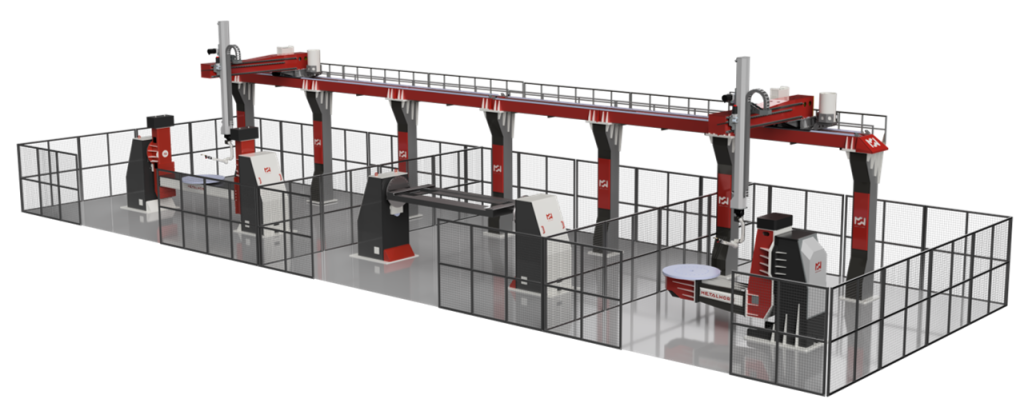
Wire Arc Additive Manufacturing, commonly known as WAAM, is transforming how researchers and manufacturers approach large-scale metal additive manufacturing. Instead of removing material from a solid block through conventional machining, WAAM deposits metal wire layer by layer using an electric arc as the heat source. When the process is combined with advanced robotic movement, monitoring systems and intelligent control, it becomes a powerful platform for developing new materials and improving manufacturing processes.
Table of Contents
A robotic WAAM system gives researchers much greater control over torch position, travel speed, deposition direction and build strategy. This level of control is essential because even a small change in heat input, wire-feed speed or layer timing can affect the shape, strength and internal structure of a deposited component. By creating a controlled and repeatable research environment, robotic WAAM allows universities, laboratories and industrial R&D teams to test ideas more efficiently and convert experimental findings into reliable manufacturing knowledge.
What Is a Robotic WAAM System?
A robotic WAAM system uses an industrial robot or collaborative robot to guide a deposition torch along a programmed path. Metal wire is continuously fed into an electric arc, where it melts and forms a weld pool. The robot moves the torch across the work surface, allowing the molten material to solidify in a carefully planned shape. Additional layers are deposited until the required three-dimensional component or test sample has been created.
The robot plays a much larger role than simply moving the torch from one point to another. It controls travel speed, angle, orientation and distance from the workpiece. Researchers can also programme different deposition patterns, layer sequences and movement strategies. This flexibility allows them to study straight walls, curved structures, intersections, repair applications and complex toolpaths.
Robotic WAAM is particularly suitable for research because it offers repeatable movement. A manually controlled welding process may vary slightly from one sample to the next, making scientific comparison difficult. A robot can repeat the same programmed action with greater consistency, helping researchers identify whether a change in performance was caused by the material, the process parameters or the movement strategy.
Why WAAM Research Requires Precise Process Control
WAAM may appear simple because it uses familiar welding principles, but producing a high-quality component involves many connected variables. Wire-feed speed determines how much material enters the weld pool, while robot travel speed affects how that material is distributed. Arc current, voltage, shielding gas, torch angle and interpass temperature can all influence the deposited bead.
These variables do not work independently. Increasing wire-feed speed without changing travel speed may produce a wider or taller bead. Increasing heat input may improve fusion but can also cause distortion, excessive heat accumulation or changes in microstructure. A parameter combination that performs well during the first few layers may behave differently as the component becomes hotter.
A robotic research platform allows engineers to test these relationships methodically. They can change one variable while keeping the others constant, produce comparable samples and evaluate the results. This structured approach turns WAAM development from uncontrolled trial and error into a repeatable scientific process.
Accelerating the Development of New Materials
One of the most promising uses of robotic WAAM is the development and testing of new metallic materials. Conventional alloy development can involve expensive production methods, long lead times and large quantities of raw material. WAAM allows researchers to produce smaller experimental samples and evaluate different material compositions more efficiently.
Researchers may test commercially available welding wires, specially developed feedstocks or combinations of different wires. They can study whether a material deposits smoothly, how it reacts to repeated heating and whether it develops cracks, porosity or unwanted phases. The deposited samples can then be analysed for hardness, tensile strength, corrosion resistance, fatigue performance and microstructure.
Robotic control improves the value of these experiments by making the deposition conditions more consistent. When each sample is produced using a documented toolpath and process schedule, researchers can compare material performance with greater confidence. This makes it easier to identify promising alloy compositions and eliminate unsuitable options before moving to larger production trials.

Supporting New Alloy Processing
Robotic WAAM can also support in-situ alloying, where two or more feed materials are introduced during deposition to create a new composition. By adjusting the ratio of the feed materials, researchers can study how gradual changes in chemistry affect the deposited metal.
This approach can be used to explore functionally graded materials. A component may begin with one composition and gradually transition into another, allowing different areas to provide different properties. For example, one region may offer structural strength while another provides improved wear, heat or corrosion resistance.
Creating these transitions requires accurate material delivery and process control. Differences in melting temperature, thermal expansion and solidification behaviour may lead to cracking or weak interfaces. Robotic WAAM systems give researchers the flexibility to adjust movement, energy input and deposition sequence while studying how the materials interact.
Understanding Thermal History and Microstructure
Heat management is one of the most important challenges in WAAM. Every deposited layer adds more heat to the component, while earlier layers may be reheated several times as the build progresses. This repeated heating and cooling creates a complex thermal history.
Thermal history affects grain size, grain direction, phase formation, hardness and residual stress. The lower section of a WAAM component may experience a different thermal cycle from the upper section, even when the same process settings are used throughout the build. As a result, material properties can vary across the component.
Robotic WAAM systems allow researchers to examine these effects under controlled conditions. They can adjust dwell time between layers, introduce cooling strategies or set limits for interpass temperature. Temperature sensors and thermal cameras may also be used to observe how heat moves through the component.
By comparing thermal data with microstructure and mechanical testing, researchers can determine which process conditions produce the required material properties. This information helps them create process maps and manufacturing guidelines that can later be applied to industrial production.
Improving WAAM Process Development
Material selection is only one part of successful WAAM. Researchers must also develop a reliable process for depositing the material. This includes choosing suitable arc settings, robot speeds, wire-feed rates, layer heights and path strategies.
Robotic WAAM systems allow teams to compare different approaches efficiently. They may test unidirectional and bidirectional paths, straight and oscillating movements, continuous and segmented deposition or different torch orientations. These studies help researchers understand how movement affects bead overlap, surface quality, heat distribution and dimensional accuracy.
Process development also involves identifying a stable operating window. The fastest deposition setting may not provide the best quality, while an overly cautious setting may reduce productivity without delivering meaningful benefits. Robotic experimentation helps researchers balance deposition rate, stability, geometry and material performance.
Once a reliable process window has been identified, the settings can be documented and repeated. This creates a stronger foundation for scaling the technology from laboratory samples to larger industrial components.
Using In-Situ Monitoring for Better Control
Traditional inspection often takes place after a component has been completed. In WAAM, however, a defect may begin in an early layer and remain unnoticed while more material is deposited. This can waste wire, machine time and research resources.
In-situ monitoring allows researchers to observe the process while deposition is taking place. Cameras can monitor the weld pool and bead shape, thermal sensors can measure temperature, and electrical signals can reveal changes in arc behaviour. Laser or vision systems may also measure layer height and surface geometry.
Monitoring becomes even more valuable when it is connected to feedback control. If a sensor detects that the layer height is becoming too large, the system may adjust the robot path or process parameters. If excessive heat accumulation is detected, the programme may increase cooling time before the next layer.
This type of adaptive control helps WAAM systems respond to real manufacturing conditions instead of relying entirely on fixed settings. It can improve consistency, reduce defects and support the development of more dependable additive manufacturing processes.
Enabling Digital Twin Research
A digital twin is a virtual representation of a physical machine, process or component that is connected to real operating data. In robotic WAAM, a digital twin may combine the robot programme, deposition parameters, sensor measurements, geometry and thermal information.
Researchers can use this virtual model to understand what is happening during the build. They may compare predicted temperature behaviour with actual sensor readings or identify where the deposited geometry is moving away from the intended design. The digital record also improves traceability because every section of the component can be linked to its process history.
Digital twins can support simulation, process prediction and machine learning. With enough reliable data, researchers may develop models that predict bead dimensions, identify unstable conditions or recommend parameter adjustments. This can reduce the number of physical experiments required and help teams reach suitable process settings more quickly.
Benefits for Academic and Industrial Research
Robotic WAAM systems create value for universities, research institutes and industrial innovation centres. Universities can use them to teach metal additive manufacturing, robotics, welding engineering, process control and materials science. Students can gain practical experience by designing experiments, programming toolpaths and analysing deposited samples.
Research organisations can use WAAM platforms to investigate alloys, sensors, adaptive control systems and repair techniques. Industrial R&D teams can test materials or manufacturing strategies on a laboratory system before transferring successful results to larger production equipment.
This reduces the risk of using expensive production machinery for early experiments. It also creates a structured path from research to commercial application. Instead of moving directly from an idea to full-scale manufacturing, teams can validate the material, process and monitoring strategy under controlled conditions.
How Robotic WAAM Shortens the Innovation Cycle
The traditional development cycle for a new metal process may involve separate equipment for welding, robotics, monitoring and testing. Integrating these systems can consume significant time before meaningful research begins. A dedicated robotic WAAM platform reduces this complexity by bringing key capabilities into one research environment.
Researchers can move more quickly from digital design to deposition, measurement and analysis. Failed experiments also become more useful because the recorded data can reveal why a problem occurred. Each test contributes to a growing process database rather than becoming an isolated result.
The real acceleration does not come only from depositing metal faster. It comes from learning faster. When process conditions are repeatable and data is properly recorded, researchers can make informed decisions, refine their experiments and transfer successful findings into practical manufacturing solutions.
Conclusion
Robotic WAAM systems are becoming important tools for advancing metal additive manufacturing research. They provide the movement accuracy, flexibility and repeatability required to study new materials, process parameters, thermal behaviour and complex deposition strategies.
By combining robotic control with in-situ monitoring and digital-twin technologies, researchers can move from basic experimentation towards intelligent and adaptive manufacturing. They can understand not only whether a component can be deposited, but why a process works and how it can be repeated reliably.
For academic laboratories and industrial R&D teams, robotic WAAM offers a practical bridge between material science, welding, automation and digital manufacturing. Platforms such as MetalWorm MW-LAB help researchers convert innovative ideas into validated processes that can support the next generation of metal production.
FAQ's
1. What is robotic WAAM?
Robotic WAAM uses a programmable robot to guide an arc-deposition torch while metal wire is melted and deposited layer by layer. It supports repeatable metal additive manufacturing and process research.
2. How does robotic WAAM support material innovation?
It allows researchers to test different wires, alloy combinations and thermal conditions under controlled settings. Deposited samples can then be evaluated for microstructure and mechanical performance.
3. What is in-situ monitoring in WAAM?
In-situ monitoring uses sensors, cameras and process signals to observe deposition while it happens. It can help identify instability, temperature changes and geometric errors before the build is completed.
4. Can robotic WAAM be used for digital-twin research?
Yes. Robot movement, welding data, sensor readings and component geometry can be connected to a virtual model for process analysis, prediction and control.
5. Who can benefit from a WAAM research system?
Universities, research institutions and industrial R&D teams can use it for alloy development, process optimisation, robotic programming, monitoring research and manufacturing education.