
Call Us 24/7
+91 9900003300Send Us Mail
support@lodestar3d.com
Call Us 24/7
+91 9900003300Send Us Mail
support@lodestar3d.com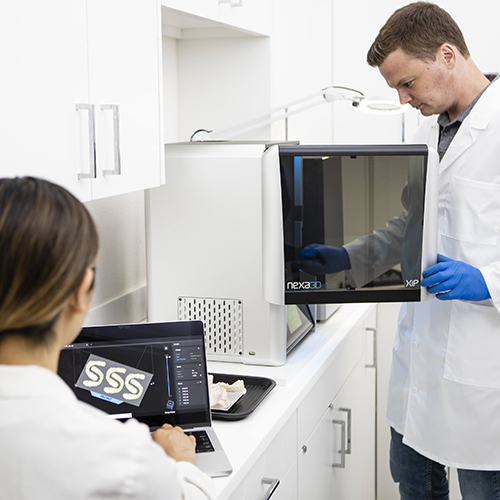
Evaluate printers for dental models, frameworks, restorative workflows, and batch production.
Compare metal 3D printers for crowns, bridges, partial frameworks, and implant-supported workflows where validated.
Plan workflows for dental models, aligner model support, retainers, trays, and appliance-related production aids.
Build education, training, research, CAD/CAM, and additive manufacturing learning environments.
Explore digital dentistry workflows for in-house planning, model production, and dental lab coordination.
Compare larger metal 3D printers for scalable production, larger build volumes, and higher throughput.
Avoid direct clinical claims unless validated by Lodestar’s brochures, OEM documentation, or relevant regulatory documentation. Use language such as “supports workflows for,” “suitable for evaluation,” or “used in workflows where validated.”
| Benefit | What It Means for Dental Businesses |
|---|---|
| Faster turnaround | Labs can reduce delays in model, framework, and production workflows when digital steps are planned correctly. |
| Repeatability | Digital files make it easier to reproduce consistent outputs across cases and production batches. |
| Customization | Every dental case can be designed around patient-specific scan data and digital design requirements. |
| Scalable production | Labs can move from pilot production to higher-volume workflows by choosing printers with suitable build volume and throughput. |
| Digital collaboration | Clinics, labs, and manufacturers can work from scan data, CAD files, and structured production workflows. |
Resin printers are commonly used for dental models, aligner models, surgical guide workflows, splints, try-ins, education models, and other resin-based workflows depending on validated material compatibility.
Best suited for: clinics, orthodontic labs, education labs, and model-heavy dental labs.
Metal printers can support crowns, bridges, removable partial denture frameworks, implant bars, brackets, and durable metal dental production workflows where the printer, powder, and post-processing workflow are validated.
3D Systems discusses dental metal 3D printing applications such as removable partial dentures, crowns, bridges, and implant bars on its dental metal 3D printing resource page.
A lab printing models may not need the same system as a prosthodontic lab producing metal frameworks or a manufacturer running batches.
Review whether your workflow needs resin, cobalt-chromium, titanium alloy, stainless steel, or other compatible materials.
Compact systems may fit smaller labs. Larger multi-laser systems may fit high-volume dental manufacturing.
Look at slicing, nesting, file preparation, layout automation, process control, and ease of use.
Metal parts may need powder removal, heat treatment, support removal, finishing, polishing, or surface treatment.
Industrial dental 3D printer pricing depends on model, configuration, material, installation, training, and support.
Larger systems should be evaluated based on build volume, laser configuration, production targets, software, material compatibility, and site readiness.
| Printer | Best Fit | Key Details | CTA |
|---|---|---|---|
| EP-M150 Dental | Dental labs exploring metal crowns, bridges, and bracket workflows. | Lodestar states that EP-M150 Dental can print metal dental crowns, bridges, and brackets. | Get Details |
| TH-M150 | Entry-level metal additive manufacturing for dental labs. | Build volume: 153 × 153 × 120 mm. Layer thickness: 20–120 μm. | Get Details |
| NCL-M100 | Compact metal 3D printing for smaller labs and pilot production. | Materials include Ti, Ti alloy, Co-Cr, and stainless steel. Max build size: 100 × 80 mm. | Get Details |
| NCL-M150 | Dental-specific metal printing for growing labs. | Optional single or dual laser configuration with compatibility for Ti, Ti alloy, Co-Cr, stainless steel, and aluminum. | Get Details |
| Lodestar 3D-M100D Lite | Desktop dental metal printing. | Build volume: 100 × 50 mm with optional 80 mm print height. Supports titanium alloy and stainless steel. | Get Details |
| FastForm-DeskFab | Desktop metal printing for dentistry, education, and research. | Specialized for dentistry with 100 × 100 mm build volume. Supports cobalt-chromium and titanium alloy. | Get Details |
| Small dental lab | Starting with metal 3D printing, limited space, lower-volume output, or pilot production. | Consider: M100D Lite, NCL-M100, TH-M150, EP-M150 Dental, DeskFab. |
| Growing prosthodontic lab | Handling crowns, bridges, frameworks, and prosthodontic workflows. | Compare: NCL-M150, FF-M140, FF-M220. |
| Orthodontic lab | Focused on aligner models, retainers, trays, and appliance-support workflows. | Confirm resin, metal, or hybrid workflow needs. |
| Dental college | Needs CAD/CAM learning, digital dentistry training, research, and lab demonstrations. | Consider: DeskFab, M100D Lite, compact systems. |
| Dental manufacturer | Needs larger build volumes, repeatable production, and scalable throughput. | Compare: FF-M300, FF-M420, FF-M800. |
The best dental 3D printer depends on the labs application, production volume, material needs, and budget. A small dental lab may prefer a compact system such as Lodestar 3D-M100D Lite, NCL-M100, or FastForm-DeskFab, while a high-volume manufacturer may need a larger production system such as FastForm-FF-M420 or FastForm-FF-M800.
Dental 3D printers can support crown and bridge workflows when the printer, powder or resin, software, and post-processing workflow are suitable for that application. Lodestar states that EP-M150 Dental can print metal dental crowns, bridges, and brackets on its product page.
Resin dental 3D printers are commonly used for models, guides, splints, aligner models, and other resin-based workflows where materials are validated. Metal dental 3D printers are used for durable metal workflows such as crowns, bridges, partial frameworks, implant bars, and other metal parts, depending on printer and material compatibility.
Dental metal 3D printing workflows may use cobalt-chromium, titanium alloy, stainless steel, and other compatible metals depending on the printer and application. Lodestars NCL-M100 lists Ti, Ti alloy, Co-Cr, and stainless steel as printing materials.
Dental 3D printing can support denture and partial framework workflows when the right printer, material, and post-processing steps are used. For clinical or patient-contact use, the full workflow must be validated before production.
Industrial dental 3D printer pricing depends on the model, build volume, laser configuration, material compatibility, software, installation, training, and support requirements. Lodestar 3D recommends requesting a quote so the team can suggest the right printer based on your labs workflow and production needs.
Choose a desktop or compact printer if your lab has lower production volume, limited space, or wants to start with digital metal workflows. Choose an industrial system if your lab needs larger build volume, higher throughput, multi-laser capability, and scalable production.
Lodestar 3D is based in Bengaluru and provides industrial 3D printer solutions, materials, software, and surface treatment systems for businesses in India. Use the quote form to discuss Pan-India support, installation, and application guidance.
The best dental 3D printer depends on the labs application, production volume, material needs, and budget. A small dental lab may prefer a compact system such as Lodestar 3D-M100D Lite, NCL-M100, or FastForm-DeskFab, while a high-volume manufacturer may need a larger production system such as FastForm-FF-M420 or FastForm-FF-M800.
Dental 3D printers can support crown and bridge workflows when the printer, powder or resin, software, and post-processing workflow are suitable for that application. Lodestar states that EP-M150 Dental can print metal dental crowns, bridges, and brackets on its product page.
Resin dental 3D printers are commonly used for models, guides, splints, aligner models, and other resin-based workflows where materials are validated. Metal dental 3D printers are used for durable metal workflows such as crowns, bridges, partial frameworks, implant bars, and other metal parts, depending on printer and material compatibility.
Dental metal 3D printing workflows may use cobalt-chromium, titanium alloy, stainless steel, and other compatible metals depending on the printer and application. Lodestars NCL-M100 lists Ti, Ti alloy, Co-Cr, and stainless steel as printing materials.
Dental 3D printing can support denture and partial framework workflows when the right printer, material, and post-processing steps are used. For clinical or patient-contact use, the full workflow must be validated before production.
Industrial dental 3D printer pricing depends on the model, build volume, laser configuration, material compatibility, software, installation, training, and support requirements. Lodestar 3D recommends requesting a quote so the team can suggest the right printer based on your labs workflow and production needs.
Choose a desktop or compact printer if your lab has lower production volume, limited space, or wants to start with digital metal workflows. Choose an industrial system if your lab needs larger build volume, higher throughput, multi-laser capability, and scalable production.
Lodestar 3D is based in Bengaluru and provides industrial 3D printer solutions, materials, software, and surface treatment systems for businesses in India. Use the quote form to discuss Pan-India support, installation, and application guidance.