SLA vs FDM for Large Prototype Models
3D printing has become an essential tool for product development and industrial prototyping. Among the most widely used technologies are SLA (Stereolithography) and FDM (Fused Deposition Modeling). Both technologies allow manufacturers to create prototypes quickly, but they differ significantly in terms of accuracy, surface finish, materials, and production capabilities.
When producing large prototype models, choosing the right technology is important to ensure design accuracy, functionality, and cost efficiency.
Table of Contents
What is SLA 3D Printing?
Stereolithography (SLA) is a 3D printing technology that uses a laser to cure liquid photopolymer resin layer by layer to create solid parts.
Industrial SLA printers such as the Lodestar SLA 1200 Industrial SLA 3D Printer offer large build volumes and extremely smooth surface finishes, making them ideal for detailed prototypes and casting patterns.
Advantages of SLA
- High dimensional accuracy
- Smooth surface finish
- Ability to print complex geometries
- Suitable for precision prototypes
SLA technology is widely used in industries such as automotive, aerospace, and product design.
What is FDM 3D Printing?
FDM (Fused Deposition Modeling) works by melting thermoplastic filament and depositing it layer by layer to build a 3D model.
FDM printers are commonly used for functional prototypes and engineering parts due to their material strength and lower cost.
Advantages of FDM
- Lower material costs
- Strong thermoplastic parts
- Suitable for functional testing
- Easy operation and maintenance
FDM is widely used for early-stage prototyping and concept models.
Key Differences Between SLA and FDM
Feature | SLA Printing | FDM Printing |
Printing Method | Laser curing liquid resin | Extruding melted filament |
Surface Finish | Very smooth | Visible layer lines |
Accuracy | High precision | Moderate precision |
Materials | Photopolymer resins | Thermoplastics (PLA, ABS, etc.) |
Detail Capability | Excellent for intricate designs | Limited for small details |
Post Processing | Resin cleaning and curing | Minimal processing |
Which Technology is Better for Large Prototype Models?
The choice between SLA and FDM depends on the purpose of the prototype.
When to Use SLA
SLA is the best choice when prototypes require:
- High detail and accuracy
- Smooth surface finish
- Complex shapes or thin features
- Visual or presentation models
Large-format SLA printers like the Lodestar SLA 1200 Industrial SLA 3D Printer allow manufacturers to produce detailed full-scale models for design validation.
When to Use FDM
FDM is more suitable when prototypes require:
- High strength
- Functional testing
- Lower production cost
- Larger batch production
It is often used for mechanical parts and engineering prototypes.
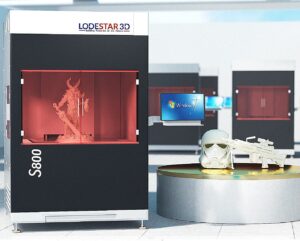
Lodestar-S800
Lodestar S800 is a high speed industrial additive 3D printer developed which enables R&D engineers covert their 3D computer designs into real objects. With its user-friendly interface and super-easy handling process, R&D engineers can develop their prototypes 10 times faster than traditional production methods.
Industries Using SLA and FDM Prototyping
Both technologies are widely used across different industries.
Common industries include:
- Automotive manufacturing
- Aerospace and defense
- Consumer product design
- Industrial equipment development
- Research and development centers
Each industry selects the technology based on prototype requirements.
Why SLA is Preferred for High-Detail Large Prototypes
For large models where visual quality and precision are critical, SLA technology is often preferred.
Advantages include:
- Fine detail reproduction
- Smooth surfaces suitable for presentation models
- High dimensional accuracy
- Ideal for casting master patterns
These characteristics make SLA a popular choice for advanced industrial prototyping.
Conclusion
Both SLA and FDM technologies play an important role in modern additive manufacturing. While FDM is cost-effective and suitable for functional parts, SLA offers superior surface quality and higher precision.
For manufacturers producing large, detailed prototype models, industrial SLA printers like the Lodestar SLA 1200 Industrial SLA 3D Printer provide excellent performance and accuracy.
Choosing the right technology depends on the prototype’s purpose, required materials, and desired level of detail.
FAQ's
SLA uses a laser to cure liquid resin, while FDM builds parts by extruding melted thermoplastic filament.
SLA provides a much smoother surface finish compared to FDM.
Yes, FDM is generally more affordable in terms of materials and machine cost.
SLA is better for highly detailed and precise prototypes.
Yes, large-format SLA printers can produce large and highly detailed prototype components.