How the WaxJet 510 Multi-Jet Wax 3D Printer Improves Jewelry Casting Accuracy
The jewelry industry is known for its intricate designs, fine detailing, and precision craftsmanship. Traditionally, jewelers relied on manual wax carving to create patterns used in investment casting. While this technique has been used for decades, it is time-consuming and prone to human error.
With the advancement of additive manufacturing, wax 3D printing has revolutionized jewelry production. Advanced machines like the WaxJet 510 Multi‑Jet Wax 3D Printer and WaxJet WJ‑530 Industrial Wax 3D Printer provide jewelers with an efficient way to create highly accurate wax patterns for casting.
Table of Contents
Understanding WaxJet 3D Printing Technology
WaxJet printing is based on multi-jet printing technology, where tiny droplets of molten wax are precisely deposited layer by layer to build a model.
Unlike traditional methods that require manual carving or molding, WaxJet printers directly produce casting-ready wax patterns from digital designs.
Key characteristics of WaxJet printing include:
- Extremely fine layer resolution
- High dimensional accuracy
- Smooth surface finish
- Consistent production quality
These capabilities make WaxJet printers ideal for producing complex jewelry patterns with intricate details.
Key Features of the WaxJet 510 and WJ-530

WaxJet 510
WaxJet 510 is a wax spray printer specifically upgraded for K-gold wax models. Its highlights lie in outstanding precision and efficient material utilization.
1. Ultra-Fine Layer Resolution
Traditional wax carving often struggles to reproduce microscopic details. WaxJet printers overcome this challenge by printing layers as thin as 8 microns (0.008 mm).
This enables the creation of:
- Intricate filigree patterns
- Micro-prong settings
- Detailed engraving
- Complex lattice structures
Such fine resolution ensures the final cast metal piece perfectly matches the original digital design.
2. Exceptional Dimensional Accuracy
Precision is critical in jewelry manufacturing, especially when designing pieces that require stone settings or assembly of multiple parts.
The WaxJet 510 Multi‑Jet Wax 3D Printer achieves ±0.008 mm tolerance, ensuring:
- Accurate gemstone placement
- Perfect fitting components
- Consistent product quality
This level of precision is difficult to achieve with manual wax modeling.
3. Ultra-Smooth Surface Finish
Surface quality plays a crucial role in casting. Rough surfaces can lead to imperfections in the final metal piece.
WaxJet printers produce ultra-smooth wax patterns, reducing the need for polishing and finishing.
Benefits include:
- Cleaner casting results
- Reduced post-processing
- Faster production turnaround
4. Eliminating Manual Wax Carving Errors
Manual wax carving requires highly skilled artisans and is often time-intensive.
Common challenges include:
- Inconsistent detailing
- Design inaccuracies
- Longer production cycles
WaxJet technology eliminates these issues by producing digitally controlled wax models directly from CAD files.
This ensures every design is reproduced with exact precision and repeatability.
5. Faster Jewelry Production
Speed is essential in modern jewelry manufacturing, especially for brands producing multiple designs.
The WaxJet WJ‑530 Industrial Wax 3D Printer features three print heads, allowing faster production compared to single-head printers.
Benefits include:
- Faster prototype development
- Efficient batch production
- Reduced time to market
Jewelers can produce multiple casting patterns simultaneously, significantly improving productivity.
Applications in Jewelry Manufacturing
WaxJet printers are widely used across different segments of the jewelry industry.
Custom Jewelry Production
Designers can create personalized rings, pendants, and bracelets with intricate patterns.
Jewelry Casting Houses
Casting foundries use wax patterns for large-scale investment casting processes.
Design Studios
3D designers can rapidly prototype new collections before launching them in the market.
Research and Development
Jewelry R&D centers experiment with innovative designs and advanced manufacturing techniques.
Advantages Over Traditional Wax Modeling
WaxJet printers provide several advantages compared to traditional manual wax carving.
Traditional Wax Modeling | WaxJet 3D Printing |
Time-consuming manual work | Automated digital production |
Limited design complexity | Highly intricate geometries |
Risk of human errors | Consistent digital accuracy |
Difficult batch production | Easy mass pattern production |
Because of these benefits, many jewelry manufacturers are shifting toward digital jewelry manufacturing workflows.
Why Jewelers Choose WaxJet Printers from Lodestar3D
Choosing the right technology partner is as important as selecting the right machine.
Lodestar Innovations Pvt. Ltd. offers comprehensive support for WaxJet printers across India.
Key advantages include:
Nationwide Installation & Training
Professional installation and training ensure jewelers quickly adopt the technology.
Reliable Material Supply
Specialized wax materials are supplied for consistent casting performance.
Technical Expertise
With more than a decade of experience in industrial 3D printing, Lodestar provides reliable consultation and support.
Complete Service Network
Annual maintenance contracts and service support ensure uninterrupted operations.
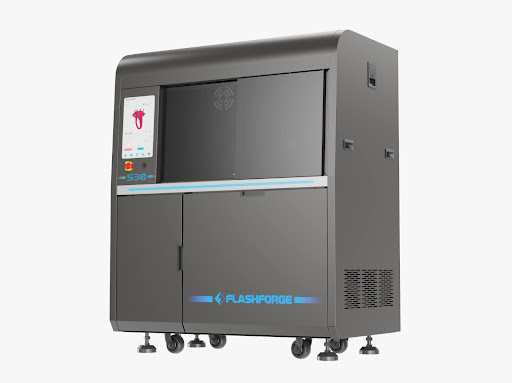
WaxJet 530
The Flashforge WJ530 is a high-output, triple-printhead wax 3D printer designed for professional jewelry manufacturing. With ultra-high precision, large build volume, and efficient material usage, it delivers fast, reliable production for intricate wax models.
The Future of Jewelry Manufacturing
Digital manufacturing technologies are rapidly transforming the jewelry industry.
WaxJet printers allow jewelers to:
- Experiment with complex designs
- Reduce production time
- Improve product quality
- Scale manufacturing operations
As consumer demand for personalized jewelry grows, technologies like the WaxJet 510 Multi‑Jet Wax 3D Printer will play an increasingly important role in modern jewelry production.
Conclusion
Accuracy is a critical factor in jewelry casting, and traditional wax modeling methods often fall short in delivering consistent results.
The WaxJet 510 Multi‑Jet Wax 3D Printer and WaxJet WJ‑530 Industrial Wax 3D Printer provide jewelers with advanced digital manufacturing capabilities. Their ultra-fine resolution, high accuracy, and smooth surface finish enable the production of flawless wax patterns for investment casting.
Supported across India by Lodestar Innovations Pvt. Ltd., these printers help jewelry manufacturers improve efficiency, reduce errors, and create stunning designs with unmatched precision.
FAQ's
WaxJet 510 has a build volume of 289 × 208 × 100 mm, while WJ-530 offers 289 × 208 × 150 mm.
Yes, WaxJet printers can produce extremely detailed designs such as filigree patterns and micro-settings.
Both printers support layer thickness between 0.008 mm and 0.015 mm.
Yes, they use direct casting wax materials that are ideal for jewelry investment casting.
WaxJet printers are supplied and supported nationwide by Lodestar Innovations Pvt. Ltd..
Supported formats include STL, SLC, CLI, and EPI.